
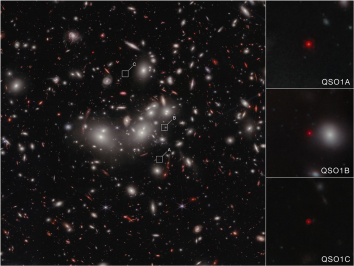
An image from NIRCam on NASA’s James Webb Space Telescope shows Abell2744-QSO1, magnified and triply imaged by galaxy cluster Abell 2744 (Pandora’s Cluster).
27 May 2026
Which comes first, the galaxy or the black hole? For decades, the standard response has been that we don’t really know, but it could be the galaxy: Large stars within an existing galaxy consume their fuel and then collapse to form black holes, which can gobble up surrounding material and merge with one another over time to form more massive entities.
The problem is that it’s hard to figure out how black holes millions to billions of times the mass of the Sun, thousands of which have now been detected in the early universe, could have grown so quickly from such small seeds.
Now, researchers using NASA’s James Webb Space Telescope, including several from UT Austin, have detected clear observational evidence that some supermassive black holes were enormous from the beginning, forming without going through a stellar collapse phase, and without a significantly more massive host galaxy to feed them.
“This is a remarkable finding,” said Roberto Maiolino of Cambridge University in the United Kingdom, co-author of two studies published today in Nature and the Monthly Notices of the Royal Astronomical Society. “It’s a paradigm shift, a total revisiting of the classical scenarios of how black holes form and grow.”
“We’re proud to be part of this groundbreaking discovery,” said Volker Bromm of UT Austin, a co-author on the papers. “UT Austin’s Cosmic Frontier Center provided the theory that this enigmatic source may be powered by a ‘primordial black hole.’ And the work is based on Texas Advanced Computing Center supercomputer simulations.”
Little Red Dot QSO1
The astronomers reached its conclusion based on detailed observations of Abell2744-QSO1 (QSO1), a prototypical Little Red Dot that existed just 700 million years after the Big Bang. It was first identified in 2023 by a team led by Lukas Furtak, now a UT Austin postdoc, and that included several UT Austin researchers at the time.
Although QSO1 is more than 13 billion light-years away and only 1,300 light-years across, it is easier to study than most other Little Red Dots because it is gravitationally lensed by galaxy cluster Abell 2744 (Pandora’s Cluster). QSO1 is both magnified and triply imaged, appearing in three different locations in the sky.
“Gravitational lensing is similar to an optical lens that magnifies faint objects, except that it is caused by general relativity: massive foreground objects bend the light from more distant background sources,” explained co-author Saiyang Zhang of UT Austin. “This magnification effect is crucial for studying the early universe because it allows us to detect and resolve objects that would otherwise be too faint or too distant to observe in detail.”
Initial studies of QSO1 revealed compelling evidence that it may be little more than a cloud of glowing hydrogen and helium gas circling a supermassive black hole, which was estimated to be on the order of 40 million times the mass of the Sun. But as with other early black holes discovered by Webb, there was uncertainty about whether it really was that massive.
“Before now, all of the mass measurements of black holes in the early universe have been indirect, based on assumptions from what we know about them in the local universe. We didn’t know if those assumptions really apply to the distant universe,” said co-author Francesco D’Eugenio of Cambridge University.
Mapping gas composition and velocity
The team recognized that if QSO1’s black hole is as massive as it looks, they should be able to use the integral field unit (IFU) on Webb’s NIRSpec (Near Infrared Spectrograph) to trace the effects of the black hole’s gravity on the gas swirling around it, while also mapping the distribution of various elements in the gas.
Cambridge graduate student Ignas Juodžbalis and Cosimo Marconcini of the University of Florence, lead authors on one of the studies, used the IFU observations to map motions of hydrogen gas surrounding the black hole. When they plotted the radial velocity as a function of distance from the center, they found that the gas has Keplerian rotation: It orbits a central point in the same way that planets in our solar system orbit the Sun.
“This is important because it tells us that most of the mass of QSO1 is concentrated in the black hole at the center,” explained Juodžbalis. “If the mass were more distributed, as it would be if there were a lot of stars, the gas would not have this perfect Keplerian rotation.”
Since Keplerian motion is governed by simple laws of gravity, the team was able to use the gas velocity measurements to calculate the black hole mass directly, a feat that had not previously been possible.
They found that not only is the black hole immense — roughly 50 million solar masses — it makes up an astonishing two-thirds of QSO1’s total mass. This proportion is thousands of times greater than in nearby galaxies, where supermassive black holes make up only a tiny fraction of the host galaxy’s total mass.
The IFU composition maps supported these results, showing that the gas throughout QSO1 is almost entirely hydrogen and helium, with very little of the heavier elements like oxygen that would be expected in a galaxy rich with stars and stellar debris. With a metallicity less than 0.5% of the Sun, QSO1 is one of the most pristine galactic environments ever measured.
“We did not initially expect that such an over-massive black hole could coexist with such a pristine environment,” said Zhang. “That combination was particularly surprising and exciting.”
“This is a phenomenal result,” added Maiolino. “It is the first direct measurement of a black hole mass within the first billion years after the Big Bang, and it is consistent with the previous measurements.” The team thinks this is a good sign that the assumptions used for indirect mass measurements are valid, and that the masses of other black holes in the early universe have not been overestimated.
Supermassive black hole origins
The outsized mass of QSO1 relative to its host galaxy suggests that it can’t have formed gradually from much smaller, stellar-mass black holes merging and feeding. “It seems that we have found a black hole that does not have a substantial host galaxy and that has predated stellar processes,” said Juodžbalis. “This is very exciting because it is evidence for primordial black holes or direct collapse black holes, which have been theorized but have not been confirmed.”
Whether QSO1’s black hole evolved from a “heavy seed” that formed within the first second of the Big Bang or somewhat later from the collapse of a giant cloud of gas, it was almost certainly born big, and may be in the early stages of building a galaxy around it.
The team thinks that Little Red Dots like QSO1 cannot have been rare in the early universe, and is in the process of analyzing similar objects to find out whether supermassive black holes actually do predate the galaxies where they currently reside.
“The direct measurement of supermassive black hole masses within the first galaxies is a key to testing theoretical models,” said Bromm. “JWST’s pioneering feat paves the way for astronomers to perform follow-up observations with the next generation of telescopes, like the Giant Magellan, deepening our understanding of these black holes’ enigmatic origins and early evolution.”
The James Webb Space Telescope is an international program led by NASA with its partners, ESA (European Space Agency) and CSA (Canadian Space Agency).
An image from NIRCam on NASA’s James Webb Space Telescope shows Abell2744-QSO1, magnified and triply imaged by galaxy cluster Abell 2744 (Pandora’s Cluster).
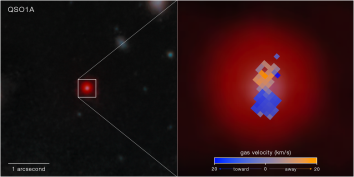
An image detail from NIRCam (left) on NASA’s James Webb Space Telescope shows Little Red Dot Abell2744-QSO1. A map of gas velocity in QSO1 (right), made using the IFU on NIRSpec, shows evidence for a 50-million-solar-mass black hole at the center.


