
Special Talk: NASA’s Artemis II Mission
On May 30 at 8:00 p.m., join us for a discussion with Jim Withrow, who works on NASA's Orion class spacecraft, central to the recent 10-day Artemis II flight test to the Moon.
On April 1, 2026, an Orion spacecraft - named Integrity by the four-member crew - lifted off of Launch Pad 39B from Kennedy Space Center. Artemis II was the first crewed flight of the NASA-led Artemis program and the first crewed flight beyond low Earth orbit since the Apollo 17 mission in 1972. Artemis II was the second flight of the Space Launch System and the first crewed flight of the Orion spacecraft. The mission supports the upcoming Artemis IV mission to return humans to the lunar surface.
Withrow will discuss the Orion spacecraft, the path Integrity took to get to the Moon, show several images and videos from the mission, and answer questions from the audience.
Livestream
For those who are unable to attend in person, this program will be livestreamed on McDonald Observatory's YouTube, Facebook, and Instagram channels.
About Jim Withrow
Jim Withrow received an engineering degree from Ohio Northern University in 1987. He has served at NASA’s John H. Glenn Research Center at Lewis Field, Ohio, for 39 years in technical and project management roles.
He spent six years advancing power systems technology for the International Space Station and helped convert a DC 9 aircraft into a microgravity research platform. As a facility manager and test director for microgravity aircraft operations, he coordinated and flew on more than 400 research flights, completing over 17,000 parabolas across six aircraft, and supporting hundreds of scientists and engineers with fluid and combustion research. He currently supports NASA’s Orion European Service Module program and serves as a propulsion functional area manager for the Service Module. His work included propulsion system testing at NASA’s White Sands Test Facility, and he supported the flights of Artemis I and Artemis II.
Mr. Withrow received the Silver Snoopy Award in 2007, an astronaut-presented honor recognizing exceptional contributions to flight safety and mission success. He also earned his glider pilot’s license in Marfa, Texas.
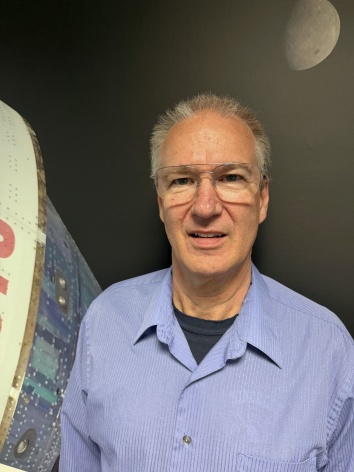
Jim Withrow