
McDonald Helps Lead NASA Mission to Study the Dust Between Stars
October 7, 2026
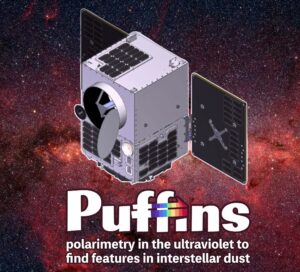 NASA is building a small space telescope specializing in detecting polarization in ultraviolet light from distant stars. From its vantage point in low-Earth orbit, the instrument – dubbed PUFFINS – will stare at a minimum of 70 stars to analyze how their light has been altered by interstellar dust on its journey to Earth.
“The science PUFFINS will do may seem a bit esoteric, but what we find will help us understand of how our universe works,” explained B-G Andersson, science principal investigator for the mission and assistant director for research support at McDonald Observatory. He has spent more than 20 years studying interstellar dust. “I’m excited for the chance to discover something new about the topic.”
“PUFFINS will change how we understand the dust between stars,” added Ramya Anche, PUFFINS’s principal investigator and an assistant research professor at the University of Arizona’s Steward Observatory. Understanding these tiny grains is essential to building a complete picture of how interstellar dust forms, evolves over time and ultimately ends up incorporated into new stars and planets, she explained.
By measuring a property of light called polarization, which describes the direction in which light waves vibrate, PUFFINS will uncover new clues about the tiny dust particles present between the stars. These particles play an important role in how stars and planets form, but scientists still have many questions about what they are made of and how they behave. Polarimetry can help provide insight because some dust grains act like microscopic compass needles, lining up with the Milky Way’s magnetic field. As starlight passes through these aligned grains, its polarization changes in ways that reveal the dust’s composition, structure, and surroundings.
At the heart of PUFFINS (short for Polarimetry in the Ultraviolet to Find Features in INterStellar dust) is a specialized telescope just 10 inches across — the size of a large dinner plate — that captures ultraviolet light from distant stars. PUFFINS will measure the polarization properties of starlight across a range of ultraviolet wavelengths using a technique called spectropolarimetry, which has not been deployed in space in nearly three decades.
“To me, PUFFINS represents the culmination of more than a decade of instrument-building work in polarimetry, and it will be the first instrument I helped design that will actually be built and launched into space,” Anche said.
PUFFINS can probe the smallest grain sizes — those smaller than about 50 nanometers, or roughly the size of the common cold virus — which are invisible to optical and infrared telescopes. Instrumentation at McDonald Observatory is expected to provide follow-observations of the gas surrounding these tiny grains, allowing for a deeper analysis and interpretation of PUFFINS data.
“We’ll be working on fully solving what for 50-plus years was the second-longest-standing mystery of interstellar medium physics,” said Andersson. “The effect of interstellar polarization — caused by elongated dust grains aligned with the magnetic field in space — was discovered in 1949 using the 82” Otto Struve Telescope at McDonald Observatory, and we’re finally beginning to understand it. That, to me, is really cool.”
The effects of interstellar dust ripple through nearly every corner of astrophysics, despite making up only about 1% of the visible mass in the Milky Way. By observing stars at different distances and in different environments — nearby stellar nurseries, reflection nebulae and even our closest extra-galactic neighbors, the Magellanic Clouds — the mission will build a detailed map of how interstellar dust varies across the sky.
PUFFINS is currently in its early design phase, with a launch target of 2030. It will serve as a critical bridge to NASA’s Habitable Worlds Observatory (HWO), the agency’s next flagship space telescope currently in development for the 2040s. HWO mission may carry a UV spectropolarimeter instrument in one of its ports, and PUFFINS data can help define what science that instrument can accomplish.
PUFFINS is a joint effort between the University of Arizona, McDonald Observatory, and a network of early-career and senior scientists from: University of Wisconsin-Madison, Space Science Institute, IPAC, University of Denver, Space Research Institute of the Austrian Academy of Sciences, Leiden Observatory, Korea Astronomy and Space Science Institute (KASI), Chalmers University, South African Astronomical Observatory, Inter University Center for Astronomy and Astrophysics, and Indian Institute of Astrophysics.
Related Posts
August 14, 2024
McDonald Observatory Welcomes New Assistant Director for Research Support
McDonald Observatory is pleased to announce the appointment of B-G Andersson as its new assistant director for research support. As a part of the Observatory’s management team, the assistant director oversees the allocation of observing time on the telescopes and […]
April 28, 2025
Vast Molecular Cloud Discovered Near Our Solar System
An international team of scientists, including from McDonald Observatory at The University of Texas at Austin, has discovered a potentially star-forming cloud that is one of the largest single structures in the sky and among the closest to the Sun and […]
March 27, 2024
UT Researcher Leading Project for NASA New Space Telescope
NASA’s newly announced space telescope project, UVEX (Ultra Violet EXplorer), will have researchers from The University of Texas at Austin leading several key projects as the mission examines how galaxies and stars evolve. The estimated $300 million UVEX telescope is expected to […]