
The Universe’s Secret Harvest: UT Astronomers Shed Light on “the Cosmic Grapes”
August 7, 2025
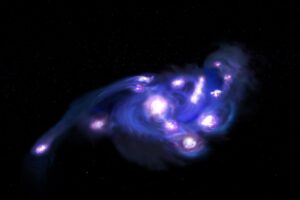
Astronomers have discovered a remarkably clumpy rotating galaxy that existed just 900 million years after the Big Bang, shedding new light on how galaxies grew and evolved in the early universe. Nicknamed the “Cosmic Grapes,” the galaxy appears to be composed of at least 15 massive star-forming clumps – far more than current theoretical models predict could exist within a single rotating disk at this early time.
The discovery – published August 7 in Nature Astronomy – was made possible by a combination of observations from the Atacama Large Millimeter/submillimeter Array (ALMA) and the James Webb Space Telescope (JWST), all focused on a single galaxy that happened to be perfectly magnified by a foreground galaxy cluster through an effect called gravitational lensing. Gravitational lensing occurs when a supermassive object, like a cluster of galaxies, warps space around itself, acting as a magnifying glass so astronomers can detect extremely faint objects that would otherwise be invisible.
“This object is known as one of the most strongly gravitationally lensed distant galaxies ever discovered,” said Seiji Fujimoto, the lead author of the paper who started this work while at the University of Texas at Austin and is now with the University of Toronto. “Thanks to this powerful natural magnification, combined with observations from some of the world’s most advanced telescopes, we had a unique opportunity to study the internal structure of a distant galaxy at unprecedented sensitivity and resolution.”
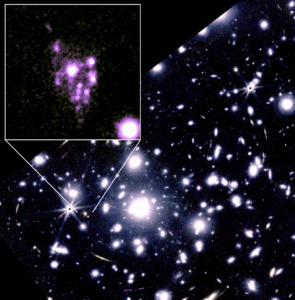
In total, more than 100 hours of telescope time were dedicated to the Cosmic Grapes, making it one of the most intensively studied galaxies from the early universe. Although the galaxy had appeared as a smooth, single disk-like object in previous Hubble images, the powerful resolution of ALMA and JWST, enhanced by gravitational lensing, revealed a dramatically different picture: a rotating galaxy teeming with massive clumps, resembling a cluster of grapes.
“These clumps are massive and have high gas densities, conditions that are conducive to forming stars very efficiently,” said Mike Boylan-Kolchin, a professor of astronomy at UT Austin and co-author on the paper. “Our observations reveal that some early galaxies’ young starlight is dominated by several massive, dense, compact clumps rather than one smooth distribution of stars.”
The finding marks the first time astronomers have linked small-scale internal structures and large-scale rotation in a typical galaxy at cosmic dawn, reaching spatial resolutions down to just ten parsecs (about 30 light-years).
This galaxy does not represent a rare or extreme system. It lies squarely on the “main sequence” of galaxies in terms of its star forming activity, mass, size, chemical composition—meaning it is likely representative of a broader population. If so, many other seemingly smooth galaxies seen by current facilities may actually be made up of similar unseen substructures, hidden by the limits of current resolution.
Because existing simulations fail to reproduce such a large number of clumps in rotating galaxies at early times, this discovery raises key questions about how galaxies form and evolve. It suggests that our understanding of feedback processes and structure formation in young galaxies may need significant revision. The Cosmic Grapes now offer a unique window into the birth and growth of galaxies – and may be just the first of many. Future observations will be key to revealing whether such clumpy structures were common in the universe’s youth.
Related Posts
July 19, 2024
Astronomers Better Identify Distance to the Cygnus Loop
The Cygnus Loop is the ethereal wreckage of a supernova explosion that occurred some 17,000-25,000 years ago. It is a cloud of dust and gas, called a nebula, steadily expanding outward from the original blast site. Because it is relatively […]
July 24, 2024
Astronomers Image Cold Exoplanet 12 Light-Years Away
An international team of astronomers using NASA’s James Webb Space Telescope has directly imaged an exoplanet roughly 12 light-years from Earth. The planet, Epsilon Indi Ab, is one of the coldest exoplanets observed to date. The planet is several times […]
July 31, 2024
Astronomers Use AI to Find Elusive Stars ‘Gobbling Up’ Planets
Astronomers have recently found hundreds of “polluted” white dwarf stars in our home galaxy, the Milky Way. These are white dwarfs caught actively consuming planets in their orbit. They are a valuable resource for studying the interiors of these distant, […]