
Some Young Suns Align with Their Planet-forming Disks, Others Are Born Tilted
August 6, 2025
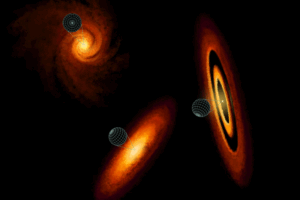
Researchers at The University of Texas at Austin, UC Santa Barbara, Yale University, and National Taiwan Normal University have found that a fair number of Sun-like stars emerge with their rotational axis tilted with respect to their protoplanetary disks, the clouds of gas and dust from which solar systems are born.
“All young stars have these disks, but we’ve known little about their orientations with respect to the spin axis of the host stars,” said UC Santa Barbara astronomer Brendan Bowler, co-author on a new study on planetary alignment published August 6 in the journal Nature. Based on the general alignment of our own Sun’s rotational axis with those of the planets in our Solar System, the assumption was that stars and their planet-forming disks emerge and rotate in or very close to alignment.
“For hundreds of years, star-planet systems were thought to form aligned at birth,” said Lauren Biddle, a postdoctoral researcher at UT Austin and lead author of the study. “Our research shows that a significant percentage of systems are born in misaligned configurations.”
Ever since exoplanets — planets that orbit other stars — were discovered in the early 1990s, the variety of spin orientations of host stars relative to the orbits of their closest planets had astrophysicists scratching their heads.
A commonly accepted explanation for this puzzle was that planets and their Suns begin life in alignment. Then, over time, passing or companion stars would tug at the system’s planets, skewing their orbits. “But there was also this question about whether these orbits were inherited from their formation process,” said Biddle. This is what she and her team set out to study.
The researchers took data from the Atacama Large Millimeter/submillimeter Array (ALMA), the Transiting Exoplanet Survey Satellite (TESS) and the repurposed exoplanet-seeking Kepler Mission (K2) to measure stellar and disk inclinations and obtain star-disk obliquity for a sample of 49 young, isolated stars and their planet-forming disks.
The result of their survey? About two-thirds of the stars and protoplanetary disks were found to be in alignment, while a third of them were misaligned. The number of misaligned stellar and planet-forming disk orientations hints at a more elegant model of the origin of planetary system tilts: some are just born that way.
“It changes our interpretation,” said Bowler. “It means that we don’t need a ton of post-formation dynamics and interactions and planet-scattering events.”
While there are Suns and planetary systems that do undergo significant interactions and can only be explained by complex dynamics, studying other stars and their solar systems gives context to our own six-degree misalignment between our own Sun and Solar System.
“If we think of science as kind of an Occam’s razor where the least complex model ends up winning out, given the data, this is a nice example of the Sun simply just fitting into this primordial, stellar obliquity distribution,” Bowler said.
Future work in this realm may include further investigations into just how these Sun-like stars and their protoplanetary disks create these tilted orientations during the earliest stages of solar system formation.
“Now we know that at least a third of them are tilted,” said Bowler, but why this is the case remains unanswered.
Adapted from a press release by UC Santa Barbara.
Related Posts
July 19, 2024
Astronomers Better Identify Distance to the Cygnus Loop
The Cygnus Loop is the ethereal wreckage of a supernova explosion that occurred some 17,000-25,000 years ago. It is a cloud of dust and gas, called a nebula, steadily expanding outward from the original blast site. Because it is relatively […]
July 24, 2024
Astronomers Image Cold Exoplanet 12 Light-Years Away
An international team of astronomers using NASA’s James Webb Space Telescope has directly imaged an exoplanet roughly 12 light-years from Earth. The planet, Epsilon Indi Ab, is one of the coldest exoplanets observed to date. The planet is several times […]
July 31, 2024
Astronomers Use AI to Find Elusive Stars ‘Gobbling Up’ Planets
Astronomers have recently found hundreds of “polluted” white dwarf stars in our home galaxy, the Milky Way. These are white dwarfs caught actively consuming planets in their orbit. They are a valuable resource for studying the interiors of these distant, […]