
Meet Zoe Hackshaw, Ph.D. Student and Galactic Archaeologist
By Medha Sarin
November 17, 2026
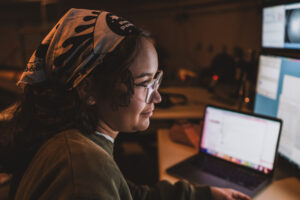
Zoe Hackshaw is a Ph.D. student in astronomy studying the history of the Milky Way galaxy. We spoke with her about her research, what it’s like being a female researcher in astronomy, and her public outreach work with Astronomy on Tap—a live, monthly event that brings science to the masses—and through social media. The following interview was edited for length and clarity.
Your research is in stellar spectroscopy and galactic archaeology. What does that mean?
Stars are like fossils that tell us about the Milky Way’s past. I split the light from stars up into its principal components, which gives me a spectrum of each star. Different elements will emit and absorb light at different specific wavelengths, so I can tell what the star is made of chemically. The carbon in our bodies, the calcium in our bones, the oxygen we breathe in—those were all created after the Big Bang, either during the life or the death of stars. I can use the stars to look back into time and see how the elements formed and evolved, which tells me how stars formed and evolved, and to do what’s called chemical cartography—essentially mapping the Milky Way.
You co-authored a paper with UT astronomer Keith Hawkins last year about a black hole 33 times the mass of the sun. What did this project entail?
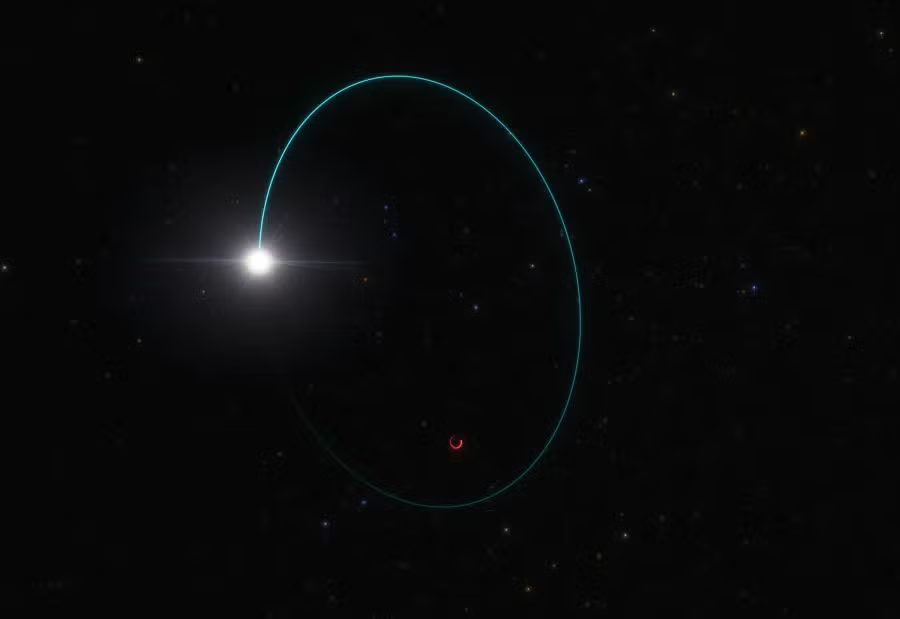
I was looking at this really weird binary system—a red giant star that’s 0.8 times the mass of our sun orbiting around a black hole that’s 33 times the mass of our sun, which is the biggest stellar mass black hole ever discovered. Stellar mass black holes form when a star runs out of fuel, explodes as a supernova and then collapses. These black holes tend to be one to 10 times the mass of our sun. So it’s strange that this one is so massive.
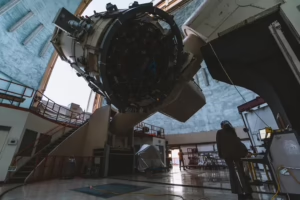
I went out to McDonald Observatory and looked at this red giant for 44 hours to get a high-resolution image and spectrum of the star to do an in-depth chemical analysis. I wanted to know, did the black hole form by itself and then later capture the red giant? Or were they two stars already orbiting each other and then one collapsed into a black hole?
What did you find?
I essentially compared the red giant star to a bunch of its neighbors to see if it was chemically similar or not. If it was not chemically similar, I would say that it’s due to pollution from a supernova. But because I did not see any chemical differences between this red giant star and its neighbors, there isn’t any evidence of a nearby supernova on the star. I think that the red giant just happened to get a little bit too close to an existing black hole.
What does it mean to you to be a female researcher in a male-dominated field?
I faced a lot of microaggressions as an undergrad, like, “Are you sure you want to study astrophysics? You don’t look like you should be doing that.” I’ve had the opportunity to give talks in classrooms across the country. It’s heartwarming to think that for a lot of these classrooms I’m entering, I am maybe the first representation of an astrophysicist that people are seeing. Also, I get letters from little girls that are like, “Thank you for talking in my classroom. Now I want to be an astrophysicist when I grow up.”
I know that I can be a little Gen Z or girly pop. Whenever I give a presentation, there’s going to be pink in it. I had a professor tell me, “It’s going to undervalue your science.” What’s the difference between this or blue? I am met with pieces of resistance like that along the way, but I’m pushing past it anyway. It’s fun to prove those people wrong.
For that younger version of myself that was like, “Can I present super feminine and still be an astrophysicist, which seems so at odds with that?” It’s about growing up, maturing, and realizing that not only are those things not at odds, but they complement each other really beautifully.
You help organize the local Astronomy on Tap group. What is that and what do you enjoy about it?
Astronomy on Tap is a group that hosts monthly public science nights at a brewery in Austin. I very much enjoy cultivating and creating events and community, and so I knew that was something that I wanted to be a part of. And who doesn’t love just drinking a beer and listening to science?
We’ve had a wide variety of fun talks, but for me, what’s always really impactful are the personal moments. I’ve had a dad and his son come up to me, show me his iPad where he was looking up astro-related things, and ask me about it. I’ve had somebody that was considering going back to school ask for my advice. Just being able to encourage people and nurture a love of astronomy and curiosity about the world around them has been really fun.
And you communicate about science online too?
A pet project of mine is an Instagram account I started, @theastrozo, to communicate my science. I think that a mark of a good scientist is not only being able to speak super eloquently and use jargon in a way that makes your colleagues think that you’re super smart, but also being able to explain it to an eight-year-old. Why should he care? Or a 70-year-old woman, why should she care? Just showing people that a scientist can be anyone.
How did your family influence your personality?
My dad is from Trinidad and Tobago, and my mom is from Jamaica. With that Caribbean influence—very loud, very boisterous, very fun—I often had to be loud myself, which has enabled me to navigate these spaces in which it might not always be easy to have your voice heard. I’m really grateful for my parents.
Does your family follow your research?
My dad reads all my papers and is my number one supporter, even though he was not ever into physics and didn’t finish college. One of the most special experiences I’ve had was taking my dad out to McDonald Observatory to give a presentation with the Department of Astronomy Board of Visitors. When we were driving there, my dad said, “Who’d have thought that a little boy from Trinidad would be all the way out here because of his daughter?” I almost started sobbing. It’s been really, really cool to share that with my dad, but also with so many other people in my community.
Related Posts
July 13, 2023
Chemical Cartography Reveals the Milky Way’s Spiral Arms
Keith Hawkins, assistant professor of astronomy at The University of Texas at Austin, has used chemical cartography – also known as chemical mapping – to identify regions of the Milky Way’s spiral arms that have previously gone undetected. His research, published […]
August 22, 2024
Board of Visitors 2025 Summer Meeting Takes Place July 26-27
Our thanks for another wonderful Board of Visitors meeting! Over 207 members and guests joined us to experience VIP access to McDonald Observatory, learn about the cutting-edge science taking place there, and to connect with one another. Thanks to clear […]
July 31, 2024
Astronomers Use AI to Find Elusive Stars ‘Gobbling Up’ Planets
Astronomers have recently found hundreds of “polluted” white dwarf stars in our home galaxy, the Milky Way. These are white dwarfs caught actively consuming planets in their orbit. They are a valuable resource for studying the interiors of these distant, […]