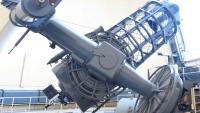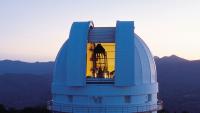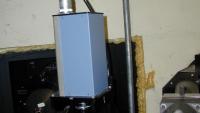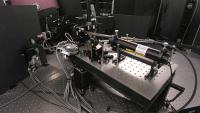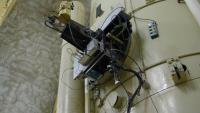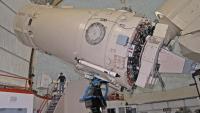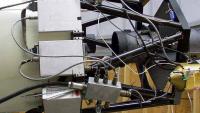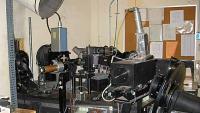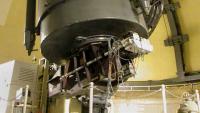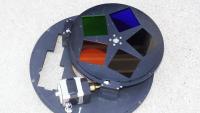

Though instruments are not as well-known as the telescopes that use them, telescopes would be useless without them. A telescope gathers and focuses light so that it can be fed into an instrument that will do specific things to that light. What happens to the light once it enters the instrument depends on what types of cosmic questions the instrument was designed to study. When beginning an observing project, an astronomer chooses which instrument will work best. Often scientists build new instruments specifically for their research. McDonald Observatory has many instruments, most of which are designed to fit onto a particular telescope.
Here are some of the research instruments currently in use at McDonald Observatory:
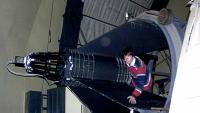
Argos Argos is an instrument that is available to use on the 2.1-meter Otto Struve Telescope. It's a photometer, which means it measures the intensity of light received by the telescope -- usually in very short time intervals. In its initial design, which was later revised, the instrument used many phototubes (tiny glass tubes that are sensitive to light) to detect incoming photons. Because of this, it was given the name Argos in honor of the many-eyed monster from Greek mythology. Instead of phototubes, however, Argos uses a CCD to make observations of the night sky.
More »
|
Cassegrain SpectrographThe Cassegrain Spectrograph was constructed by the Boller and Chivens company for the Otto Struve 2.1-meter telescope. The astronomer can chose the wavelength region, the resolution, and the length of the slit (allowing different spatial coverage from 0.5 to 120 arcseconds). This flexibility means objects as small as stars or as large as extended galaxies may be observed. More »
|
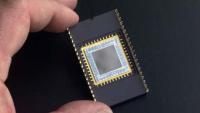
Charged Coupled Devices Every night, light from celestial sources streams into telescopes at observatories around the world. After passing through various instruments and optics, each beam of light is brought into focus on a detector. Light sensitive detectors are essential for studying astronomy because they record the intensity and position of the light that has traveled so far to reach us. Previous generations of astronomers were accustomed to using glass photographic plates or even their unaided eyes as detectors to study light from the night sky. However, today astronomers use detectors called Charged-Coupled Devices, or CCDs, controlled by complex electronics, to make their observations.
More »
|
CoolSpec and ROKCAM CoolSpec is a low- to medium-resolution near-infrared spectrograph available on the 2.7-meter Harlan J. Smith Telescope at McDonald Observatory. It is always with a camera called ROKCAM. Both CoolSpec and ROKCAM are designed to study light at wavelengths between 1 and 2.5 micrometers, a region of the electromagnetic spectrum called "near-infrared." This kind of light is slightly less energetic, or slightly redder, than visible light.
More »
|
Coudé spectrometer There are four different configurations of the Coudé Spectrometer on the 2.7 meter Harlan J. Smith Telescope. The instruments are spectrographs, meaning they separate light into its component colors, creating a spectrum for astronomers to study. More »
|
Diffraction Gratings A diffraction grating is an optical component that is used to spread or disperse light into a spectrum. At observatories, diffraction gratings are used in spectrographs so that astronomers may study the spectra of light from celestial sources. A diffraction grating consists of a small piece of glass into which many thousands of tiny parallel lines have been etched. When light interacts with the diffraction grating, the etched lines, which are usually called grooves, cause it to be spread into its component colors. There are two types of diffraction gratings: transmission gratings and reflection gratings. Transmission gratings create a spectrum when light passes through them. Reflection gratings, on the other hand, create a spectrum when light is reflected off them. It is possible to see an everyday example of a spectrum created by tiny etched lines by tilting a compact disk in a light source. The rainbow visible on the surface of the disk is the spectrum that results when light bounces off the disk's grooves. More »
|
EyepieceAstronomers no longer look through eyepieces on research telescopes to do their research, but eyepieces are still important at McDonald Observatory. More »
|
Guiders Collecting light from astronomical objects is often very difficult because people do not observe the heavens from a stationary point. As Earth turns on its axis, objects such as the Sun, Moon, and stars appear to travel though the sky. In order to compensate for this motion, many types of amateur and professional telescopes alike are designed to track the stars as they move overhead. Tracking simply involves moving the telescope in right ascension at a constant rate - this follows the rotation of the Earth, and causes the stars to appear stationary in the field of view of the telescope. More »
|
High Resolution Spectrograph The Hobby-Eberly Telescope hosts a trilogy of spectroscopic instruments, Of these, the High-Resolution Spectrograph offers the highest resolution. It can discern fine features in the spectra from astronomical sources by spreading the spectrum out more than the other spectrographs. More »
|
Imaging Grism Instrument and Polarimeter (IGI, IGP) The Imaging Grism Instrument, IGI (rhymes with piggy), is an instrument built by Dr. Gary Hill and can be used at the Cassegrain focus of either the 2.7-meter Harlan J. Smith Telescope or the 2.1-meter Otto Struve Telescope. IGI is a very simple instrument that performs the following three functions: focal reducer, spectrometer, and polarimeter. More »
|
Large Cassegrain Spectrograph One of the instruments available for use on the 2.7-meter Harlan J. Smith Telescope is the Large Cassegrain Spectrograph. It spreads light into its component colors, just as a prism spreads white light into a rainbow. It is located at the Cassegrain focus of the telescope, which means that the light collected by the primary mirror comes into focus at a point just behind the mirror though a hole in the middle of the mirror. More »
|
LCS-SpectropolarimeterThis is an adaptation another instrument that allows astronomers to study the polarization of light from celestial objects. More »
|
Linear PolarimeterThe linear polarimeter, implemented at McDonald Observatory in 1978, is designed for use at the Cassegrain focus of the Otto Struve 2.1-meter telescope. Light coming from astrophysical sources is often polarized due to magnetic fields, spinning dust grains, or other phenomena. This instrument is used to measure the polarization state of this light from an object as we view it from Earth. More »
|
Marcario Low Resolution Spectrograph The Low Resolution Spectrograph, LRS, is an instrument at the prime focus of the Hobby-Eberly Telescope (HET). More »
|
Medium Resolution SpectrographThe Medium Resolution Spectrograph (MRS) was built by a team of astronomers at Pennsylvania State University led by Larry Ramsey. The instrument saw its first light on August 7, 2002 and is now available for public use. The MRS is one of three spectrographs on the Hobby-Eberly Telescope (HET); the others are the Low and High Resolution Spectrographs (LRS and HRS). MRS allows for higher resolution spectroscopy than the LRS and better sensitivity than the HRS and, therefore, bridges a gap between these two instruments. More »
|
Millisecond InfraRed Astrophysical Spectrophotometer MIRAS, the Millisecond Infra-Red Astrophysical Spectrophotometer, is an instrument designed by Dr. Paul Harvey, a professor at UT. This instrument, which is generally outfitted on the Harlan J. Smith 2.7 meter (107-inch) telescope, is unique from other instruments at McDonald in that it doesn't directly observe the object in question. MIRAS uses the lunar occultation technique. More »
|
Multiple InstrumentsSometimes astronomers need to use more than one instrument to probe certain pieces of the cosmic puzzle. More »
|
Observer-provided instrumentSomestimes astronomers bring their own instruments to use on McDonald's telescopes, rather than choosing from among McDonald's many available instruments. More »
|
P45 PhotometerA photometer is an instrument that literally counts how many photons hit the detector from the astronomical object being observed. More »
|
Prime Focus CorrectorThe Prime Focus Corrector, or PFC, is the instrument currently used on the 0.8-meter telescope. The PFC takes images of celestial objects. As a prime focus instrument, it is located at the open end of the telescope tube. Light enters the telescope from an area on the sky and is reflected from the 0.8-meter mirror into a focal plane. The instrument is placed at the front of the telescope, in the focal plane. Once inside the PFC, light passes through a filter and onto a detector called a charged-coupled device, or CCD. More »
|
Sandiford Cassegrain Echelle Spectrometer The Sandiford Cassegrain Echelle Spectrometer is an instrument often used on the 2.1 meter Otto Struve Telescope. It is a spectrometer, which means that it spreads incoming light into its component wavelengths for astronomers to study. The light is spread by an echelle, which is a special type of diffraction More »
|
UBVRI filters When using a telescope to make images of celestial objects, astronomers often place special pieces of glass called filters into the path of the light. Just as a coffee filter allows coffee to pass through, and blocks everything that is not coffee, an astronomical filter allows light of certain wavelengths to pass through and blocks other wavelengths. This enables astronomers to study specific colors of light from celestial sources. Astronomical filters are made of colored glass and usually measure about one square inch. More »
|
VIRUS-P The VIRUS-P instrument is a prototype for a much larger instrument planned for a major future project on the Hobby-Eberly Telescope at McDonald Observatory. Its installation on the Smith Telescope is both helping astronomers prepare for that future project, and to do interesting science today. More »
|
This program is supported by the National Science Foundation under grant AST 0227870. Any opinions, findings, and conclusions or recommendations expressed in this material are those of the author and do not necessarily reflect the views of the National Science Foundation.
|