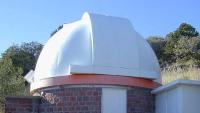

The control room of the 2.7-meter Harlan J. Smith Telescope.
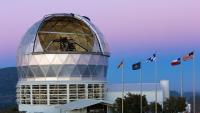
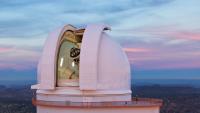
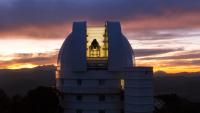
McDonald Observatory's Smith Telescope was third largest in the world when completed in 1969. Its light-gathering power is a quarter of a million times greater than that of the unaided human eye.
The telescope was built under terms of a joint contract between NASA and The University of Texas, at a total cost of about $5 million. Planning for the telescope began late in 1964, when it became clear that more large telescopes were needed to pave the way for the emerging Space Age. Soon spacecraft would explore the planets, but not before telescopes explored them first from Earth.
This telescope was built in part to serve as "eyes" on the solar system. The information gathered in McDonald's planetary program played a significant part in preparing for more detailed exploration of the solar system by manned and unmanned spacecraft and in understanding the results sent back by them.
Since its dedication in November 1969, the Smith Telescope has been in steady use every clear night. It is now used for a full range of astronomical research.
Telescope Facts Primary Mirror Diameter
2.72 meters (107 in.) Weight
3540 kg (7800 lbs.) Thickness
31.8 cm (12.5 in.) Material
Fused silica
Design Design
Charles Jones, Inc. Construction started
April 1966 Construction completed
October 1968 Telescope contractor
Westinghouse Optics
Davidson Optronics Dome
D.H. Lovell Construction Co.