
|
|
Glossary
|
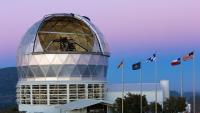
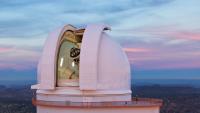
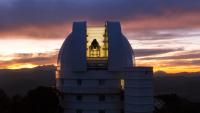
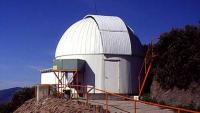
telescope An optical instrument that gathers and focuses light for use in astronomical study. Telescopes are usually shaped as tubes, and they use a series of either mirrors or lenses to focus light onto a camera, CCD, photographic plate, or eyepiece. Two major types of telescopes dominate astronomy: refracting telescopes and reflecting telescopes.
refractors
A refracting telescope uses an objective lens to gather and focus light to a focal point. The aperture size of the telescope is limited by the purity and weight of the glass lens. Several of the most magnificent telescopes are refractors. Yerkes Observatory's 40-inch refractor is the largest. Not only are the instruments mechanically and aesthetically beautiful, but they were also responsible for some of the pioneering astronomical research in the first part of the 20th century that paved the road for present-day discoveries.
reflectors
A reflecting telescope uses a primary mirror to gather and focus light to a focal point. These telescopes are used today almost exclusively in astronomical observatories. The telescope aperture can range from a few centimeters to several meters, since the mirror diameter is limited by the flexible nature of glass, mirror weight, and design of the telescope. Some telescopes overcome these problems with a segmented primary mirror.
In order to help point a telescope in the correct direction, astronomers have developed two systems of coordinates for locating objects in the sky. The first, called the alt-az system, uses altitude and azimuth coordinates. Telescopes that use this coordinate system are said to have alt-az mounts and are used mostly by amateur observers. Professional astronomy demands telescope motion to be able to track stars and faint objects in the sky for long hours. To accommodate this, the telescope must turn opposite the direction of the Earth. The equatorial system of coordinates, used by telescopes with equatorial mounts, solves this problem. The coordinates in an equatorial system are right ascension and declination.
|
temperature A measure of the average kinetic energy of the atoms or molecules that make up an object. Temperature can be measured in degrees Fahrenheit (oF), degrees Celsius (oC), or in Kelvin (K). The respective freezing and boiling points of water are 32 degrees and 212 degrees F, 0 degrees and 100 degrees C, and 273.16 and 373.16 K. One degree Celsius and one Kelvin measure the same amount of change in temperature.
When referring to the temperature of stars, astronomers usually refer to the effective temperature, or temperature of the photosphere, of a star. In the core however, the temperature is highest around 15 million degrees. In between the core and the surface, the temperature is about 5 million degrees, and at the photosphere, where almost all photons escape, the temperature is 6000 degrees.
|
terminator A distinct shadow edge that marks the boundary between the night and day side of a moon or planet. Because of shadows cast along this jagged boundary on the Moon, it is easy to see the three-dimensionality of lunar mountains and craters. Sometimes, towering crater rings still catch a bit of sunlight as they slip behind the terminator.
|
terrestrialHaving to do with the Earth. |
terrestrial planets The four inner planets of our Solar System: Mercury, Venus, Earth and Mars. They consist mainly of rocky material, including iron, sulfur, magnesium, silicon, and nickel. Unlike the outer planets, no hydrogen nor helium exists in the atmospheres of the inner planets. The inner planets are also much smaller and more dense than the outer planets. Daytime temperatures range from 600 K (621 degrees F) on Mercury to 300 K (81 degrees F) on Mars. |
TeslaA unit used by physicists to measure the strength of magnetic fields, abbreviated T. One Tesla is equal to 10,000 Gauss. |
TheoryIn science, a theory is a proposed description, explanation, or model of a set of natural phenomena, capable of predicting future occurrences or observations of the same kind, and capable of being tested through experiment or otherwise falsified through empirical observation. It follows from this that for scientists "theory" and "fact" do not necessarily stand in opposition. For example, it is a fact that an apple dropped on earth has been observed to fall towards the center of the planet, and the theory which explains why the apple behaves so is the current theory of gravitation. In scientific usage, a theory does not mean an unsubstantiated guess or hunch, as it often does in other contexts. In common usage, people often use the word theory to signify a conjecture, an opinion, or a speculation. In this usage, a theory is not necessarily based on facts, in other words, it is not required to be consistent with true descriptions of reality. True descriptions of reality are more reflectively understood as statements that would be true independently of what people think about them. |
thermal radiationEnergy that is output from a source as a result of its temperature.
|
thermonuclear fusion The process by which two atomic nuclei are merged under extremely high temperatures and pressures to make one nucleus of another element. Usually, thermonuclear fusion refers to two hydrogen nuclei that are combined to make a helium nucleus. The result of this type of reaction is a large release of energy. Thermonuclear fusion is the process that powers a star. Every star on the main sequence converts mass into energy through thermonuclear fusion. |
tidal force A stretching force that is caused by the difference between gravitational forces on opposite sides of an object, such as a planet or moon. For example, because the Moon pulls on opposite sides of the Earth with different strengths, water on the Earth is pulled either toward or away from the Moon, resulting in the ocean tides. Elsewhere in the Solar System, the magnitude of gravitational force on Jupiter's moon Io is greatest on the side of Io that faces Jupiter and least on the back side. The difference between the two forces compresses and stretches Io, which in turn heats up Io's interior. As a result, Io is the most geologically active body in the Solar System. |
total solar eclipse A type of solar eclipse in which the Sun is completely blocked by the Moon.
See also solar eclipse
|
transit The act of one celestial body passing in front of another. For example, when astronomers observe Mercury to be moving in front of the Sun, they say that Mercury is transiting the Sun. Most often, though, transit is used to refer to a celestial body crossing the meridian. The time at which a celestial object crosses the meridian is called the transit time. At the transit time, the object is highest in the sky, and light from the object travels through the thinnest possible layer of Earth's atmosphere. Thus an object's transit time marks the best time to view the object.
See also meridian
|
This program is supported by the National Science Foundation under grant AST 0227870. Any opinions, findings, and conclusions or recommendations expressed in this material are those of the author and do not necessarily reflect the views of the National Science Foundation.
|
|
|
| |
|