
Astronomers Better Identify Distance to the Cygnus Loop
By Emily Howard
July 19, 2024
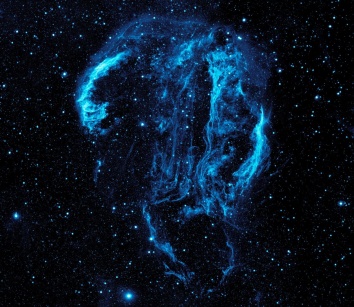
The Cygnus Loop is the ethereal wreckage of a supernova explosion that occurred some 17,000-25,000 years ago. It is a cloud of dust and gas, called a nebula, steadily expanding outward from the original blast site. Because it is relatively close to us – and beautiful! – it is a popular target for amateur astronomers exploring the cosmos through backyard telescopes. Its neighborly status also makes it a popular target for professional astronomers studying the aftereffects of supernovae.
Though it is well researched, astronomers have struggled to precisely determine how far the Cygnus Loop is from Earth. Previous estimates have ranged from 1,400 to 4,600 light years away. And when revisited with new techniques and data, many past studies on the subject turn out to be inaccurate. This limits astronomers’ knowledge of the nebula. “The distance is a key parameter for understanding many fundamental properties of the remnant,” explained Adam Ritchey, a research scientist at Eureka Scientific studying the Cygnus Loop. This includes more precise assessments of how long ago its parent supernova exploded, how much energy that explosion unleashed, and the speed of the resulting shockwave.
Now, using instrumentation at The University of Texas at Austin’s McDonald Observatory and data from the Gaia space telescope, Ritchey and his team have more precisely homed in on the nebula’s distance from us: 2,400 to 2,600 light years away.
He was joined in this work by Professors Emeritus Steve Federman at The University of Toledo and David Lambert at The University of Texas at Austin. Their results were published in the Monthly Notices of the Royal Astronomical Society.
How They Did It
Spectroscopy is a common technique used by astronomers to study the universe. Instruments called spectrographs take the light of celestial objects and break it apart into its various wavelengths. The result is a colorful spectrum that astronomers can analyze to learn about an object and its surroundings.
Although the supernova that created the Cygnus Loop occurred a long time ago, its shockwave is still travelling through space, pushing clouds of gas in its path quickly forward. As starlight travels through this gas, some of the light is absorbed by the elements that are present. The resulting spectrum has black lines, called “absorption lines,” indicating the presence of these elements. Based on if the wavelength of these elements is longer or shorter than usual, astronomers can tell if the gas is traveling toward or away from Earth and how quickly it is doing so.
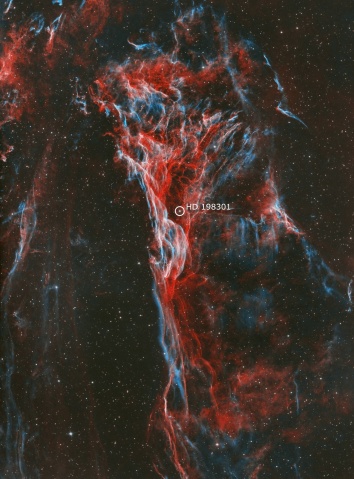
To identify how far away the Cygnus Loop is, the astronomers analyzed the light from six stars in the nebula’s vicinity, looking for signs that the light had traveled through a cloud of fast-moving gas. This would indicate that the star is located behind the nebula. Of the stars they studied, only one revealed the presence of fast-moving gas. “Observations of HD 198301 revealed such a signature,” Lambert said. This star, he added, is located behind a bright region of the nebula called Pickering’s Triangle.
Using existing data from the Gaia space telescope, the team then calculated that the distance to HD 198301 is approximately 2,800 light years. Based on how much dust in the nebula dimmed the light of nearby stars, they were able subtract 200 to 400 light years from HD 198301’s distance to identify how far the Cygnus Loop is from Earth.
As a part of the study, Ritchey and his team also identified that, based on the velocity of calcium ions in the nebula, the shockwave that is traveling through it is doing so at about 100 km/second. “This in itself is important information which helps us better understand the interaction between the supernova remnant and its surroundings,” Ritchey said.
The Right Instrument for the Job
To make their observations, the team used the Robert G. Tull Coudé Spectrograph on McDonald Observatory’s Harlan J. Smith Telescope. Interstellar gas – even when struck and energized by a supernova’s shockwave – is relatively cold and hard to detect. Evidence of its ingredient elements may only show up as very thin, faint absorption lines in a spectrum. “One key aspect when studying interstellar absorption lines is that you need very high spectral resolution,” Ritchey said. “The Tull spectrograph provides us with the high resolution we need.”
To learn even more about the Cygnus Loop, the team next hopes to use the Hubble Space Telescope to study the region in front of the star HD 198301. This will help them identify the density, temperature, pressure, and energy change in the nebula’s gas. That, in turn, will help them better understand the evolution of the Cygnus Loop.
Study authors are Adam Ritchey at Eureka Scientific; Steve Federman at The University of Toledo; and David Lambert at The University of Texas at Austin.
Related Posts
July 24, 2024
Astronomers Image Cold Exoplanet 12 Light-Years Away
An international team of astronomers using NASA’s James Webb Space Telescope has directly imaged an exoplanet roughly 12 light-years from Earth. The planet, Epsilon Indi Ab, is one of the coldest exoplanets observed to date. The planet is several times […]
July 31, 2024
Astronomers Use AI to Find Elusive Stars ‘Gobbling Up’ Planets
Astronomers have recently found hundreds of “polluted” white dwarf stars in our home galaxy, the Milky Way. These are white dwarfs caught actively consuming planets in their orbit. They are a valuable resource for studying the interiors of these distant, […]
August 26, 2024
Early Galaxies Weren’t Too Big for Their Britches After All
When astronomers got their first glimpses of galaxies in the early universe from NASA’s James Webb Space Telescope, they were expecting to find galactic pipsqueaks, but instead they found what appeared to be a bevy of Olympic bodybuilders. Some galaxies […]