
Please let us know how we can help you get the most out of your visit.
If you have questions or if your concerns are not addressed by the information provided below, please contact us.
Mobility Issues
Parking at the Frank N. Bash Visitors Center
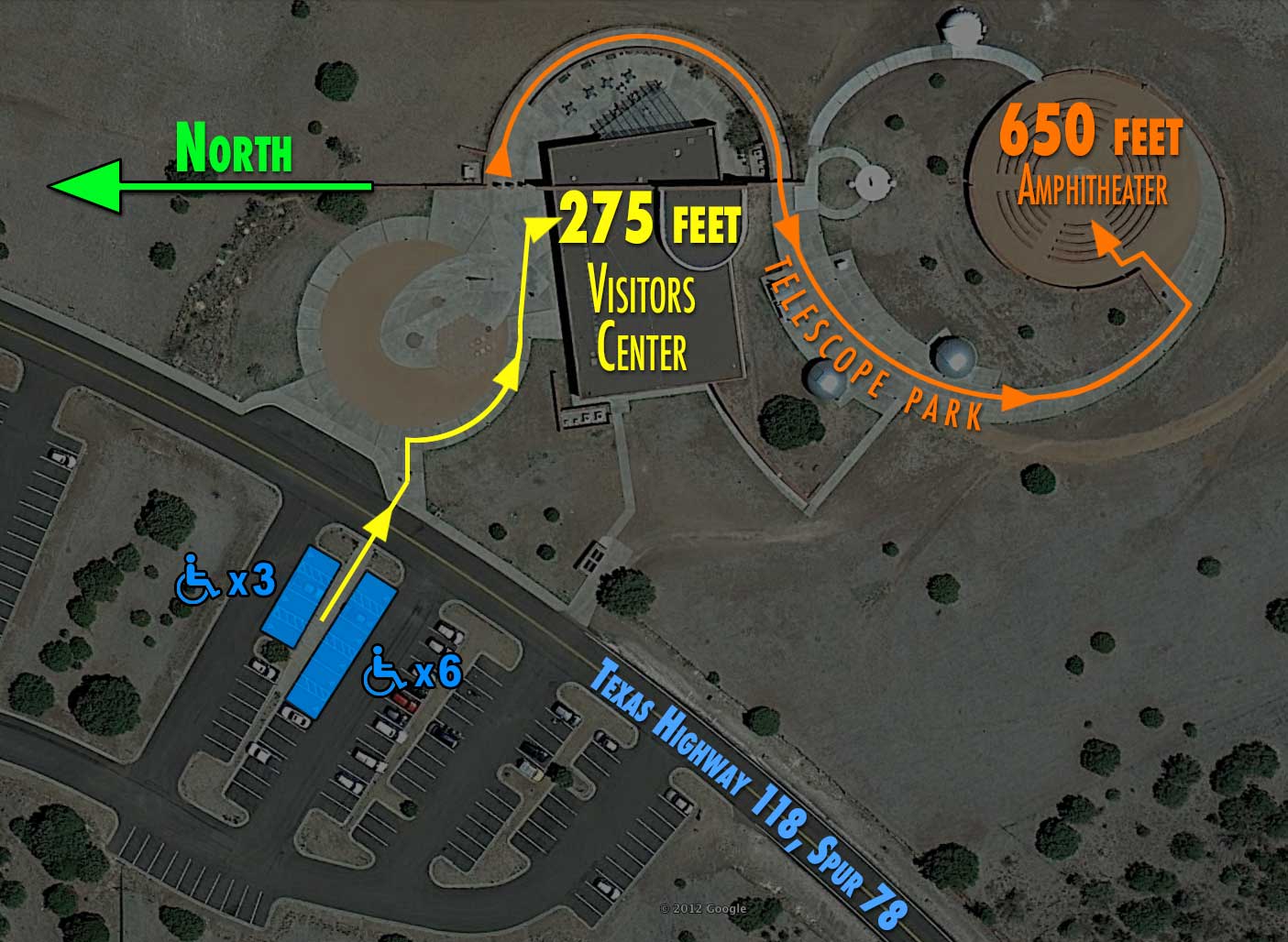
Accessible parking is provided in the main parking lot at the Frank N. Bash Visitors Center. Please note the distances to various areas around the Visitors Center.
Restrooms
Wheelchair accessible restrooms are available at the Frank N. Bash Visitors Center.
Wheelchairs/Transport Chairs
All spaces at the Visitors Center are ADA accessible.
Several transport chairs are available for use at the Visitors Center free of charge. Notify the attendant at the Information Desk if you need access to a chair. Be aware that the walk from the Visitors Center to the Amphitheater (see distances here) is inclined, rising 15 feet from the Visitors Center building to the Amphitheater building.
Respiratory Issues
The high altitude at our location can aggravate some respiratory conditions. If you require supplementary oxygen, an asthma inhaler, or other such device, be sure to bring these items with you on any programs you attend. Portable oxygen units are permitted on all programs.
Blind or Visually Impaired
Resources
We are able to provide accommodation to visitors with limited or no sight through a variety of tactile graphics, models, and other resources. Please notify us ahead of your visit so that we can prepare resources for your planned activities.
Low Light
Lighting levels are kept low at all evening programs to provide the best possible views of the night sky for all visitors. Your eyes will need time to adjust to the low light levels; please refrain from using white flashlights in the Telescope Park. Red lighting is provided throughout the Telescope Park and Amphitheater, and all telescope operators carry red flashlights. Staff are happy to provide assistance navigating the Telescope Park in low light conditions.
Deaf or Hearing Impaired
Assistive Listening
Assistive listening devices are available free of charge for all public programs. These devices consist of a small wearable receiver and earpiece or T-Coil loop. If you would like an assistive listening device, please notify the Information Desk attendant prior to the start of your program. Our staff will instruct you on how to operate the device. Please return assistive listening devices to the Information Desk at the conclusion of your program.
Scripts
Written scripts are available to accompany Solar Viewing and Guided Tours. Target information cards are available to accompany telescope views. Please notify us in advance if you would like these resources, so we can have them ready for your use.
Sign Interpretation
We cannot guarantee availability of sign interpretation services for all programs, but we will make every effort to accommodate such requests. To request sign interpretation, please email us at least one month before the date of your program.
Service Animals
In accordance with federal regulations, trained service animals accompanying their handlers/owners are welcome inside of the Visitors Center and at all of our public programs.
University of Texas policy, in accordance with the State Attorney’s General Office, does not allow pets (including emotional, comfort, or other therapy/support animals) in Observatory buildings or in indoor/at outdoor public program venues.
Health and Safety
Emergency Response
The Observatory will contact 911 in the event emergency response is required. Portable defibrillators are located at all facilities regularly accessed by the public. Program presenters are trained in emergency procedures and will assist you in the event of a building evacuation.
Sanitation
All areas of the Visitors Center, including exhibits, restrooms, and high-touch areas, are cleaned regularly. Air purifiers are in use throughout the building.