

Consortium Selects Site in Chile for Future Giant Magellan Telescope
9 October 2007
The University of Texas at Austin McDonald Observatory and Texas A&M University department of Physics have announced that the Giant Magellan Telescope (GMT) Consortium has decided to build the GMT at Las Campanas Observatory in Chile. Las Campanas is operated by the Carnegie Institution of Washington.
“I’m delighted that astronomers from the state’s two flagship universities are cooperating on this important project,” said McDonald Observatory Director Dr. David L. Lambert. The consortium also includes the Australian National University, The University of Arizona, The Carnegie Institution of Washington, Harvard University and The Smithsonian Institution.
The Giant Magellan Telescope has been under development for several years, and the first of its seven 8.4-meter (27.5-foot) mirrors was cast from molten glass in July 2005 and are being polished at the University of Arizona’s Steward Observatory Mirror Laboratory. When completed, the final surface will be smooth to an accuracy of one millionth of an inch and will follow the precise optical prescription needed to produce the best images theoretically possible.
GMT will be the first of a new generation of ground-based telescopes, and is scheduled for completion in 2016. Its large size will offer exceptional resolving power, producing images up to 10 times sharper than the Hubble Space Telescope, and will open new avenues of scientific exploration. These include understanding the origin and evolution of planetary systems beyond our own, witnessing the formation of stars, galaxies and black holes, and exploring the properties of dark matter and dark energy in the cosmos.
“With this telescope, we’ll probe frontiers of space beyond what even the Hobby-Eberly Telescope (HET) can see,” Lambert said. The 9.2-meter HET at the McDonald Observatory is one of the largest telescopes in the world.
The Las Campanas location was selected for GMT because of its high altitude, dry climate, dark skies and unsurpassed seeing quality, as well as its access to southern hemisphere skies.
“The GMT builds on the partners’ collective experience in constructing and operating world-class telescopes. Locating the telescope at a proven world-class, mountain-top site in Chile will maximize its productivity and cost effectiveness,” said Dr. Nicholas Suntzeff, head of the astronomy program at Texas A&M University.
“This decision represents a critical step towards realizing our goal of building the premier next-generation astronomical observatory,” said Dr. Wendy Freedman, leader of the GMT Board and director of the Observatories of the Carnegie Institution.
“The Giant Magellan Telescope represents the dawn of a new age of astronomical exploration,” said Dr. Charles Alcock, director of the Harvard-Smithsonian Center for Astrophysics. “As telescopes get larger, we are able to see fainter, farther, and with more clarity than ever before. We can only predict a fraction of the scientific discoveries that will be made using this enormous telescope and the new insights into the universe that we will gain.”
Las Campanas is home to the twin Magellan Telescopes, the predecessors of the new instrument.
“Excellent science has come from Las Campanas for several decades,” Freedman said. “The superb astronomical quality of the site is a significant contributor to this success.”
The Texas flagship universities are able to participate in the GMT project as a result of a $1.25 million gift to Texas A&M from George P. Mitchell of Houston and matching funds from The University of Texas at Austin. Mitchell is a 1940 distinguished graduate of Texas A&M’s Petroleum Engineering Department.
While the GMT’s purpose, design and location have been decided, its construction has not yet been funded. The partner institutions continue to seek funds for this massive undertaking.
— END —
Note to Editors: For detailed information about the design of the GMT and the science it will perform, see the GMT web site.
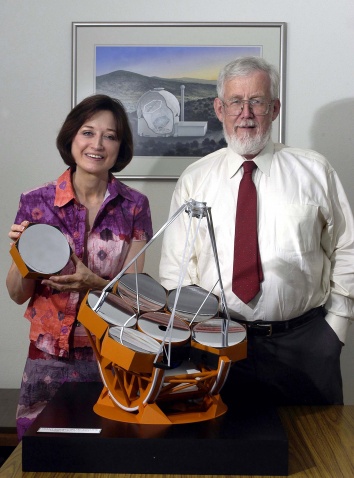
Drs. Rankin & Lambert with GMT Model
Bookmark or share this page


