
McDonald Observatory receives $5 million challenge grant to study elusive dark energy
27 April 2006
AUSTIN, Texas — Light might soon be shed on one of the great enigmas of the universe — dark energy — thanks to a $5 million challenge grant from Dallas’ Harold C. Simmons to The University of Texas at Austin. Simmons’ grant will help fund the Hobby-Eberly Telescope Dark Energy Experiment (HETDEX) at UT’s McDonald Observatory by matching the next $5 million in private support received.
Discovered in the late 1990s, dark energy is a force causing the universe to expand at an accelerating rate. But scientists are unable to say what the energy is or how it fits with the known laws of physics. “We know that it dominates the universe,” said David Lambert, a UT astronomer and the director of McDonald Observatory. “In fact, it comprises an estimated 73 percent of the universe, while so-called dark matter accounts for 23 percent, and matter of the familiar kind — the stars, galaxies, all known life — comprises only four percent.”
Simmons, the chairman of Contran Corporation, holds BA and MA degrees in economics from UT Austin. He has previously given to UT athletic programs and the McCombs School of Business, as well as to the UT Southwestern Medical Center at Dallas. He said he hopes this gift will help HETDEX make astronomical history. “I find the question of dark energy intriguing and I am glad to help support the innovative research program at McDonald Observatory.”
HETDEX is the best contender for solving the riddle of dark energy, according to Lambert, because it will combine a large telescope, a large amount of observing time, and an innovative instrument that will allow for a three-dimensional map of up to one million galaxies. “Many in the scientific community believe that understanding the nature of dark energy is the number-one question in all of science,” he said. “We cannot observe dark energy in the laboratory because its effects are seen only on enormous scales. So the universe has to be the laboratory.”
“Harold Simmons’ grant is a terrific example of how philanthropists and universities can be partners in the quest for new knowledge,” said UT President William Powers, Jr. “I share Harold’s enthusiasm in this project. The University is extremely grateful for his generosity.”
A team of three UT astronomers — senior research scientists Gary Hill and Phillip MacQueen, and associate professor Karl Gebhardt — is developing HETDEX using the Hobby-Eberly Telescope, which is the third largest in the world. With support from Simmons and other donors, the McDonald Observatory is currently upgrading the telescope’s field of view from 4 arc minutes to 20 arc minutes.
— END —
Notes:
For more information on HETDEX, please see the HETDEX website .
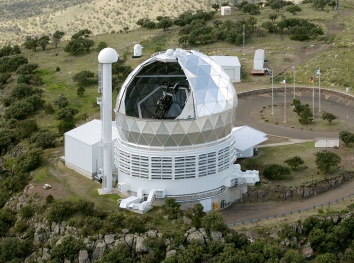
Hobby-Eberly Telescope, Aerial View
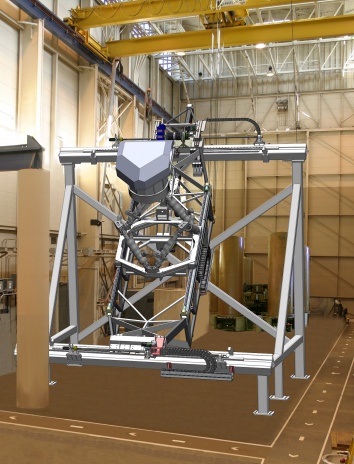
Harold C. Simmons Dark Energy Optical System (mock-up)
Bookmark or share this page


