

Mitchell Gift to Texas A&M, Support from The University of Texas at Austin Allow Flagship Universities to Join Telescope Consortium
3 August 2004
Austin, Texas—Texas A&M University and The University of Texas at Austin are joining the Giant Magellan Telescope (GMT) Consortium to explore the frontiers of our universe as the result of a $1.25 million gift to Texas A&M from George P. Mitchell of Houston and matching funds from The University of Texas at Austin.
The Texas universities will join the Observatories of the Carnegie Institution of Washington, Harvard University, the Smithsonian Astrophysical Observatory, the Massachusetts Institute of Technology, the University of Arizona and the University of Michigan as partners in the Giant Magellan Telescope Consortium.
Mitchell, a 1940 distinguished graduate of Texas A&M's Petroleum Engineering Department, made his career in energy and real estate development. He founded Mitchell Energy & Development Corp. Throughout his successful business career, Mitchell cultivated interests in philanthropy, civics and global issues, ranging from the environment to the implications of science and technology.
He provided the $1.25 million gift to Texas A&M toward the GMT project on behalf of the George P. and Cynthia W. Mitchell Institute for Fundamental Physics in the Physics Department at Texas A&M University. His gift will be matched with $1.25 million over the next two years by The University of Texas at Austin.
"This project sparked my interest because it will allow Texas A&M and UT to attract young scientists and students to further their interests in the field of physics and cosmology," Mitchell said.
The GMT Consortium plans to construct the Giant Magellan Telescope in Chile. It will consist of six 8.4-meter mirrors surrounding a seventh central mirror, all on a single steerable mounting. The telescope’s light-collecting area equals that of a single 21-meter mirror. Today’s largest telescopes, including The University of Texas at Austin’s Hobby-Eberly Telescope at McDonald Observatory in West Texas, have mirrors with effective diameters of about 10 meters. The GMT will collect five times more light than the Hobby-Eberly Telescope. It will collect about 70 times as much light as the Hubble Space Telescope and produce images 10 times sharper.
The GMT will open a path to fundamental discoveries about the origins of the universe, black holes and the genesis of galaxies and planets. It will have the power to detect light from very faint objects, the ability to distinguish fine detail despite the blurring effect of the Earth's atmosphere, and the ultimate sensitivity to infrared heat radiation from the formation of stars and planets.
"This joint project will bring Texas A&M to the front line of astronomy research," said H. Joseph Newton, dean of the College of Science. "We are grateful to Mr. Mitchell for his continued support of the Department of Physics and the College of Science."
"Mr. Mitchell’s enthusiasm for learning more about the cosmos, where we came from, and how we got where we are is one impetus for this generous gift," said Edward Fry, head of the Physics Department. "With his continuing support, the spotlight on astronomy at Texas A&M University can only grow stronger."
"Joining this consortium is a way of keeping the UT astronomy program at the top of U.S. astronomy. I shall be delighted to work with A&M," said David L. Lambert, director of McDonald Observatory.
"The questions astronomers ask are profound and strike a responsive chord in every thinking human— the origin and age of the universe, the existence of extraterrestrial life, the nature of dark matter and black holes, the search for other planets," said Mary Ann Rankin, dean of the College of Natural Sciences at The University of Texas at Austin. "Answers to such questions require extraordinary tools. The GMT is the best plan for a major improvement in Earth-based optical spectroscopy that I have seen, and I want Texas to be a founding partner in that effort."
"I am delighted that Texas A&M and UT Austin are joining the Giant Magellan, and grateful to George Mitchell for the enthusiastic generosity that catalyzed and made this extended partnership possible," said Dr. Wendy Freedman, director of the Carnegie Observatories and chair of the Giant Magellan Telescope Board.
Mitchell and his wife Cynthia are longtime benefactors of Texas A&M. The Mitchells are credited with gifts that include funding to establish both The George P. Mitchell '40 Outdoor Tennis Center and The George P. & Cynthia W. Mitchell Institute for Fundamental Physics. Continuing his support for the Physics Department, Mitchell has also established several chairs under the auspices of the Mitchell Institute: the Stephen Hawking Chair in Fundamental Physics, the Mitchell/Heep Chair in Theoretical High Energy Physics, the Mitchell/Heep Chair in Experimental High Energy Physics and the Schuessler/Mitchell/Heep Chair in Experimental Optical and Biomedical Physics.
The Mitchells have also provided funding for an endowed chair in Astronomy/Cosmology, a second Chair in Theoretical High Energy Physics and an endowed Career Enhancement Award for a new young faculty member in Astronomy/Cosmology. As evidenced by the chair titles, the Herman F. Heep and Minnie Belle Heep Texas A&M University Foundation has also been a significant contributor and has matches to the latter three Mitchell endowments under consideration.
The Mitchells have also made many gifts to The University of Texas at Austin, including support for the University of Texas Elementary Charter School and unrestricted funds and faculty support for the School of Architecture and the College of Engineering.
— END —
Note to editors: This information is being released simultaneously by The University of Texas at Austin, Texas A&M University, and Dancie Perugini Ware Public Relations.
Image caption: The Giant Magellan Telescope consists of six 8.4-meter mirrors surrounding a seventh central mirror, mounted on single steerable platform. Once completed, the telescope will collect 70 times as much light as the Hubble Space Telescope and produce images 10 times sharper. Graphic by Matt Johns, Carnegie Observatories.
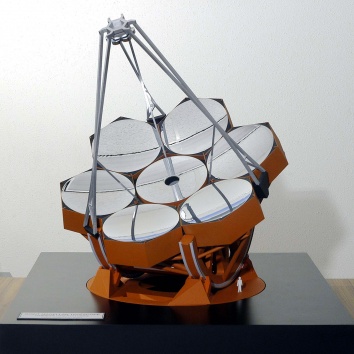
GMT Model
Bookmark or share this page


