

Scientists Develop Cheap Method for Solar System Hunt Using McDonald Observatory Telescope
19 November 2003
AUSTIN, Texas—University of Texas at Austin astronomers have invented an inexpensive method to determine if other solar systems like our own exist.
Among the more than 100 stars now known to have planets, astronomers have found few systems similar to ours. It’s unknown if this is because of technological limitations or if our system is truly a rare configuration. The McDonald Observatory astronomers’ novel search method uses a Depression-era telescope mated with today’s technology.
Astronomers Don Winget and Edward Nather, graduate students Fergal Mullally and Anjum Mukadem, and colleagues are looking for the "leftovers" of solar systems like ours. Their method searches for the pieces of such a solar system after its star has died, by exploiting a trait of ancient, burnt-out Suns called "white dwarfs."
University of Texas astronomers Bill Cochran and Ted von Hippel are also involved, along with S.O. Kepler of Brazil’s Universidade Federal de Rio Grande dol Sul and Antonio Kanaan of Brazil’s Universidade Federal de Santa Catarina.
Astronomers know that as Sun-like stars use up their nuclear fuel, their outer layers will expand, and the star will become a "red giant" star. When this happens to the Sun, in about five billion years, they expect it will swallow Mercury and Venus, perhaps not quite reaching Earth. Then the Sun will blow off its outer layers and will exist for a few thousand years as a beautiful, wispy planetary nebula. The Sun’s leftover core will then be a white dwarf, a dense, dimming cinder about the size of Earth. And, most important, it likely will still be orbited by the outer planets of our solar system.
Once a Sun-like system reaches this state, Winget’s team may be able to find it. Their method is based on more than three decades of research on the variability (that is, changes in brightness) of white dwarfs. In the early 1980s, University of Texas astronomers discovered that some white dwarfs vary, or "pulsate," in regular bursts. More recently, Winget and colleagues discovered that about one-third of these pulsating white dwarfs (PWDs) are more reliable timekeepers than atomic clocks and most millisecond pulsars.
These pulsations are the key to detecting planets. Planets orbiting a stable PWD star will affect observations of its timekeeping, appearing to cause periodic variations in the patterns of pulses coming from the star. That’s because the planet orbiting the PWD drags the star around as it moves. The change in distance between the star and Earth will change the amount of time taken for the light from the pulsations to reach Earth. Because the pulses are very stable, astronomers can calculate the difference between the observed and expected arrival time of the pulses and deduce the presence and properties of the planet. (This method is similar to that used in the discoveries of the so-called "pulsar planets." The difference is, the pulsar companions are not thought to have formed with their stars, but only after those stars had exploded in supernovae.)
"This search will be sensitive to white dwarfs which were initially between one and four times as massive as the Sun, and should be able to detect planets within two to 20 AU from their parent star. This means we’ll be probing inside the habitable zone for some stars," Winget said. (An AU, or astronomical unit, is the distance between Earth and the Sun.) "Basically, detecting Jupiter at Jupiter’s distance with this technique is easy. It’s duck soup," he said.
Easy, but not quick. Outer planets, orbiting their stars at large distances, can take more than a decade to complete one orbit. Therefore, it can take many years of observations to definitively detect a planet orbiting a white dwarf.
"You need to look for a long time for a full orbit," Winget said. "A half-orbit or a third of an orbit will tell us something’s going on there. But for a planet at Jupiter’s distance, a half-orbit is still six years." Winget added that for this method, "detecting Jupiter at Uranus’ distance is easier, but takes even longer."
For the PWD planet search, Nather conceived a specialized new instrument for McDonald Observatory’s 2.1-meter Otto Struve Telescope. He and Mukadam designed and built the instrument, called Argos, to measure the amount of light coming from target stars. Specifically, Argos is a "CCD photometer" — a photon counter that uses a charge-coupled device to record images. Located at the prime focus of the Struve Telescope, Argos has no optics other than the telescope’s 2.1-meter primary mirror. Copies of Argos are now being built at other observatories around the world.
Mullally continues the search for planets around white dwarfs with Argos on the Struve Telescope. He has 22 target stars, most of which were identified through the Sloan Digital Sky Survey. When the team finds promising planet candidates with Argos, they will follow up using the 9.2-meter Hobby-Eberly Telescope (HET) at McDonald Observatory.
"If we find large planets orbiting at large distances, that’s a good clue that there might be smaller planets closer in. In that case, what you do is pound away on that target with the largest telescope you have access to," Winget said. The HET will enable more precise timing of the PWD’s pulses, and thus be able to pinpoint smaller planets.
This search will be able to study types of stars unable to be studied with the doppler spectroscopy method — the most successful planet search method to date — Winget said. Because of idiosyncrasies in the make-up of Sun-like stars, the doppler spectroscopy method is not very sensitive in looking for planets around stars twice as massive as the Sun. Roughly half of the stars in Winget’s study will be white dwarfs that were originally these types of stars. For this reason, the PWD study at McDonald can be instrumental in scouting and assessing targets and observing strategies for NASA space missions planned in the next two decades, specifically the Space Interferometry Mission, Terrestrial Planet Finder and Kepler spacecraft.
This research is funded by a NASA Origins grant, as well as an Advanced Research Project grant from the State of Texas. Through funding from the Texas Higher Education Agency, two secondary schoolteachers (Donna Slaughter of Stony Point High School in Round Rock, Texas, and Chris Cotter of Lanier High School in Austin) have been directly involved in this research. Plans are now underway to extend this involvement to other teachers, and the students in their classrooms by bringing the science, scientists and the Observatory directly into the classroom using the Internet. Cotter and his colleagues at Lanier High School are involved with Mullally in testing this concept.
— END —
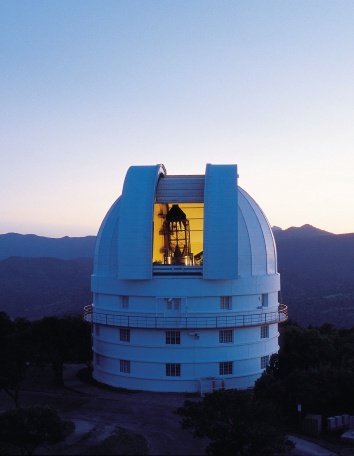
Otto Struve Telescope, Dome
Bookmark or share this page


