
2026 Board of Visitors Summer Meeting Provides Front Row Seat to the Cosmos
By Emily Howard
July 27, 2026
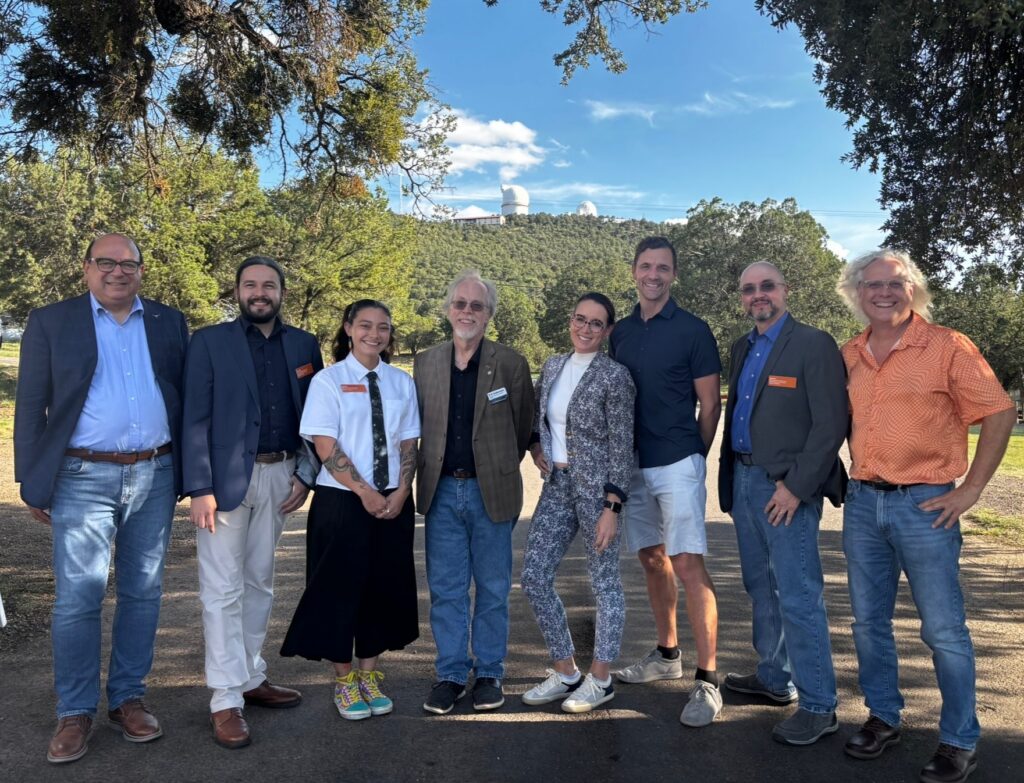
July 10-11, 2026, marked another exciting Board of Visitors meeting at McDonald Observatory. Thanks to everyone who made the trip to West Texas to join us.
This year’s event included:
- Talks on topics ranging from supernovae to white dwarfs to globular clusters
- Telescope tours
- Stargazing both nights under clear skies
Over 200 BOV members attended the event! We hope you had as much fun visiting the Observatory as we did having you.
Our next meeting will take place February 12-13, 2027, on The University of Texas at Austin campus. See you there.
Science Talks
Time Domain Astronomy in the Era of Big Data
Sebastian Gomez, Assistant Professor
Supernovae are an important source for studying the formation of elements, the composition of stars, and the expansion of the universe. As we enter an era of new, large-scale astronomy surveys, the number of identified supernovae has exploded. For example, the Vera C. Rubin Observatory, which started observations in February, is finding one every 12 seconds.
However, it’s one thing to find a supernova, and it’s another to understand it. The second requires follow-up observations using telescopes with spectrographs, which can tell astronomers about the nature of an object based on the light it emits. Not every supernova merits follow-up observations, so Gomez has created machine learning programs that can sift through large datasets, identifying the best candidates for ongoing research. This software can also be used to identify black holes ripping apart stars, super luminous supernovae in the early universe, and other relatively short-lived events.
The Universe HETDEX Unlocked
Dustin Davis, HETDEX Postdoctoral Fellow
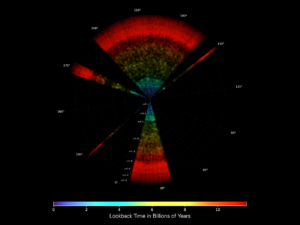
From 2017 to 2024, the Hobby-Eberly Telescope Dark Energy Experiment (HETDEX) undertook the largest survey to date of the early universe. In its quest to understand dark energy, HETDEX has mapped the location of more than a million galaxies present 10 billion to 12 billion years ago. It has also captured data on all of the space between those galaxies, which is proving to be a treasure trove for astronomers.
Davis provided an overview of some of the research making use of this data. Astronomers are plotting the large-scale structure of the universe based on oxygen-emitting galaxies and, separately, based on the distribution of excited hydrogen; searching for the first generation of stars, called Population III stars, which have yet to be detected; finding new trends in the relationship between early black holes’ masses and that of their galaxies’ stars; and much more.
So far, this research has been led exclusively by HETDEX scientists with access to the dataset. However, in June, that dataset was made public, opening the door to even more discovery.
HETDEX Reveals an Unbiased Census of Ionizing Photon Escape at Low Redshifts
Maya Debski, Ph.D. Student
Debski described how HETDEX data is helping astronomers study the Epoch of Reionization. Occurring 150 million to one billion years after the Big Bang, this is a period when the first galaxies produced ionizing radiation, called Lyman Continuum or “LyC” radiation, and transformed the universe from opaque to transparent.
Because these distant LyC emitting galaxies are so difficult to observe, Debski searches for nearby Magnesium II (MgII) emitting galaxies instead. Observations demonstrate that nearby galaxies emitting MgII are also leaking LyC radiation and share many other properties with their Reionization-era predecessors. They are small, faint, and contain very little dust – all qualities that astronomers think the galaxies that drove reionization also possessed. Thus, MgII emitters serve as excellent stand-ins for earlier LyC emitting galaxies, allowing researchers to investigate physical processes in far greater detail.
Though more easily observed than distant galaxies, nearby MgII-emitting galaxies are still very rare. It is only the sheer scale of the HETDEX survey that has allowed Debski to find a significant sample size of 300 MgII emitters.
Despite her sample adding up to only less than .05% of all HETDEX galaxies, Debski has nevertheless compiled the largest library of nearby Magnesium-II emitters ever created. This is an incredible resource that will prove invaluable to astronomers studying the Epoch of Reionization.
Science Discussion Groups
Exploring Late Stages of Planetary Evolution through Observations of White Dwarf Stars
Zach Vanderbosch, HET Resident Astronomer
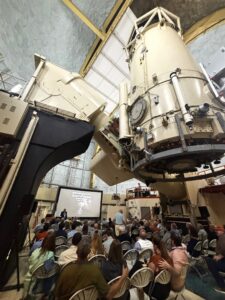
Vanderbosch discussed how white dwarfs—the dense remnants left behind when Sun-like stars die—can provide a unique window into the fate of planetary systems. White dwarfs have atmospheres composed almost entirely of hydrogen and helium, but roughly 30% contain traces of heavier elements. These “polluted” white dwarfs are the result of planets being torn apart by the star’s gravity and their material scattered onto its surface.
By studying both this pollution and clouds of planetary debris orbiting white dwarfs, Vanderbosch is expanding our knowledge of the composition of planetary systems outside of our own. His research uses the Gaia Space Telescope, Caltech’s Zwicky Transient Facility, and McDonald Observatory’s Hobby-Eberly Telescope.
Seeing Red: Could JWST’s “Little Red Dots” Be Globular Clusters in the Making?
John Chisholm, Assistant Professor
Globular clusters are dense collections of ancient stars. Although astronomers have studied these objects for well over a century, their origins remain unknown. That’s because we only see them billions of years after their birth. One clue to their origins may lie in their unusual chemistry: many contain unexpected over and under abundances of elements. In his talk, Chisholm suggested that a short-lived supermassive star present in a cluster’s earliest stages could explain these distinctive chemical fingerprints.
This scenario could explain the mysterious Little Red Dots discovered by the James Webb Space Telescope. Based on Chisholm’s research, some Little Red Dots may actually be young globular clusters in the process of forming, briefly illuminated by a central supermassive star before evolving into the clusters seen today.
Understanding the Smallest Dust Using the Shortest Wavelengths: The NASA Ultraviolet Polarimetry Mission PUFFINS
B-G Andersson, Assistant Director for Research Support at McDonald Observatory
The space between stars isn’t empty. It’s filled with vast clouds of gas and tiny particles of dust that play an important role in how galaxies evolve and how new stars are born. That dust also affects nearly every astronomical observation because it can block, scatter, and re-emit light as it travels through space. To understand the universe, astronomers need to understand dust.
One of the most powerful ways to study this dust is through polarization—a subtle change in starlight caused by tiny grains that become aligned in space. The smallest grains leave their strongest signatures at ultraviolet wavelengths, but Earth’s atmosphere blocks most UV light, meaning these observations must be made from space.
With Andersson as the Science Principal Investigator, NASA’s PUFFINS mission will study what these microscopic particles are made of, how they interact with magnetic fields, and how they influence our view of everything from nearby stars to the distant universe. The mission is scheduled to launch in 2030.
Cosmic Time Machines: Using Today’s Chemically Primitive Galaxies to Decode Our Cosmic Origins
Danielle Berg, Assistant Professor
Within their cores, stars are able to forge new elements. With each generation of stars, heavier and heavier elements are created. As a result, measuring the chemical contents of galaxies can help reveal their age and evolution.
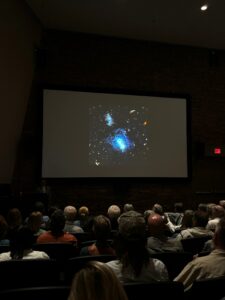
Berg discussed how rare nearby galaxies with very low amounts of heavy elements—called metal-poor galaxies—can act as “cosmic time machines,” offering a glimpse into the conditions that shaped the universe’s first stars and galaxies. She uses surveys like the Sloan Digital Sky Survey and Dark Energy Spectroscopic Instrument to identify possibly metal-poor galaxies and do follow-up observations from McDonald to reveal their true nature. Because these metal-poor neighbors have a similar chemistry to the first galaxies they can act as a valuable resource for studying the early universe.
Berg’s leadership role on NASA’s UVEX mission is expected to expand our understanding of these galaxies even more.
Related Posts
March 30, 2026
2026 Board of Visitors Winter Meeting Shares Cutting-Edge Science
The Department of Astronomy and McDonald Observatory welcomed the Board of Visitors to The University of Texas at Austin campus on March 6-7 for its annual winter meeting. Over the course of two days, 130 BOV members joined science leaders, […]
August 26, 2025
Board of Visitors Summer Meeting Showcases Breakthroughs in Cosmic Discovery
Friday, July 25, through Saturday, July 26, McDonald Observatory hosted the annual Board of Visitors Summer Meeting. Featuring science talks, discussion groups, and telescope tours and viewings, the event connected almost 200 attendees with the latest astronomical research. Although there […]
August 22, 2024
Board of Visitors 2025 Summer Meeting Takes Place July 26-27
Our thanks for another wonderful Board of Visitors meeting! Over 207 members and guests joined us to experience VIP access to McDonald Observatory, learn about the cutting-edge science taking place there, and to connect with one another. Thanks to clear […]