
2026 Board of Visitors Winter Meeting Shares Cutting-Edge Science
By McDonald Observatory
March 30, 2026
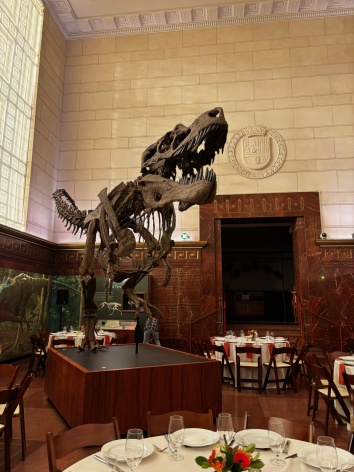
The Department of Astronomy and McDonald Observatory welcomed the Board of Visitors to The University of Texas at Austin campus on March 6-7 for its annual winter meeting. Over the course of two days, 130 BOV members joined science leaders, faculty, and students for an exploration of the cutting-edge science currently underway at UT Austin and the new windows it is opening to our universe.
The meeting started on Friday evening with a reception, dinner, and awards ceremony at the Texas Science & Natural History Museum. On Saturday, participants convened in San Jacinto Hall for program updates and science talks.
This year’s talks discussed:
- How astronomers use chemistry to understand the evolution of far-off galaxies
- The violent end of stars around black holes
- Curious galaxies present at the dawn of time, known as Little Red Dots
- How chemical cartography can reveal the shape, composition, and evolution of the Milky Way
Our thanks to all who were able to attend this year’s event. It’s always a pleasure to connect and to share the pioneering work made possible by the Board of Visitors’ generous support.
Science Talks
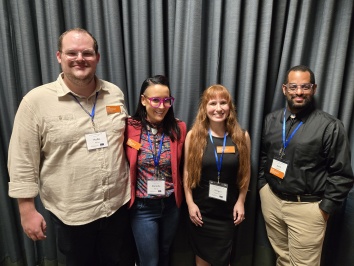
A Race Against the Clock: How the Earliest Galaxies Became Element-Rich So Quickly
Danielle Berg, Assistant Professor
Galaxies grow over time through star formation, with stars forging new elements in their cores. Because these elements form on different time scales and under different conditions, astronomers can use a galaxy’s chemistry to calculate its age and evolution. In her talk, Berg discussed how observations from the James Webb Space Telescope reveal that galaxies present in the early universe appear more chemically mature than established models would predict. In particular, they contain far more nitrogen than expected for such young systems.
Berg explained how this surprising result points to extreme conditions in the early universe that allowed galaxies to evolve more quickly than previously thought. By studying these distant systems, as well as those nearby, astronomers are building a clearer picture of how galaxies and elements formed over time.
Supermassive Black Hole Neighborhoods: Mapping Dust, Gas, and Rogue Stars in the Centers of Galaxies
Megan Newsome, Postdoctoral Fellow
At the center of most galaxies lies a supermassive black hole, usually hidden from view by immense clouds of dust, debris, and gas. Newsome’s work focuses on rare moments when those regions briefly reveal themselves: when a star wanders too close to a black hole and is torn apart by its powerful gravitational forces.
These short-lived events (often occurring over the course of days or months) create a dramatic flare, illuminating the otherwise obscured centers of galaxies. Newsome described how observations of these flares from McDonald Observatory’s Hobby-Eberly Telescope are helping her and others understand the chemistry of stars and galaxies, the dense clouds of debris surrounding black holes, and the conditions that lead to the death of these wayward stars.
The Nature of JWST’s “Little Red Dots”: Mysterious Objects Harboring Monstrous Black Holes in the Early Universe
Hollis Akins, Ph.D. Student
Among the most unexpected discoveries from the James Webb Space Telescope is a population of compact, luminous galaxies known as Little Red Dots. When they were first observed, some suggested that cosmology was “broken.” If all of the light coming from these objects was from stars, it implied that some galaxies had grown so big, so fast, that theories could not account for them.
Akins shared how a growing body of evidence that now suggests many Little Red Dots are early galaxies hosting supermassive black holes at their cores. But more research is needed. To better understand these galaxies, Akins is combing through JWST data and documenting their locations. This will allow others to conduct targeted follow-up observations, gaining insight on this unique class of galaxies and how they came to be.
The Great Lecture: Galactic Archaeology — The History of Our Cosmic Home
Keith Hawkins, Associate Professor
Data from the Gaia space satellite, coupled with a technique called “chemical cartography,” enables Hawkins to identify the location and properties of celestial objects based on their chemical composition. Applying this approach, he has charted the distribution of metals (any element heavier than hydrogen or helium) in our Milky Way galaxy. Because metals are forged in the interiors of stars, finding these elements allows Hawkins to identify the density and age of stellar populations. His work confirms that our galaxy is, indeed, spiral-shaped and that its oldest region is located towards the galactic center.
As lead of the Sloan Digital Sky Survey, Hawkins looks forward to using chemical cartography to map portions of the Milky Way on the far side of its central black hole, revealing the shape of this region’s own spiral arms.
Related Posts
July 2, 2024
Bass Foundation Gift Strengthens Outreach at McDonald Observatory
McDonald Observatory is honored to announce a generous gift of $4 million from the Harry W. Bass Jr. Foundation. Funds will support updates to McDonald Observatory’s Frank N. Bash Visitors Center and improve and expand the Observatory’s visitor experience. “We […]
August 14, 2024
McDonald Observatory Welcomes New Assistant Director for Research Support
McDonald Observatory is pleased to announce the appointment of B-G Andersson as its new assistant director for research support. As a part of the Observatory’s management team, the assistant director oversees the allocation of observing time on the telescopes and […]
August 22, 2024
Board of Visitors 2025 Summer Meeting Takes Place July 26-27
Our thanks for another wonderful Board of Visitors meeting! Over 207 members and guests joined us to experience VIP access to McDonald Observatory, learn about the cutting-edge science taking place there, and to connect with one another. Thanks to clear […]