
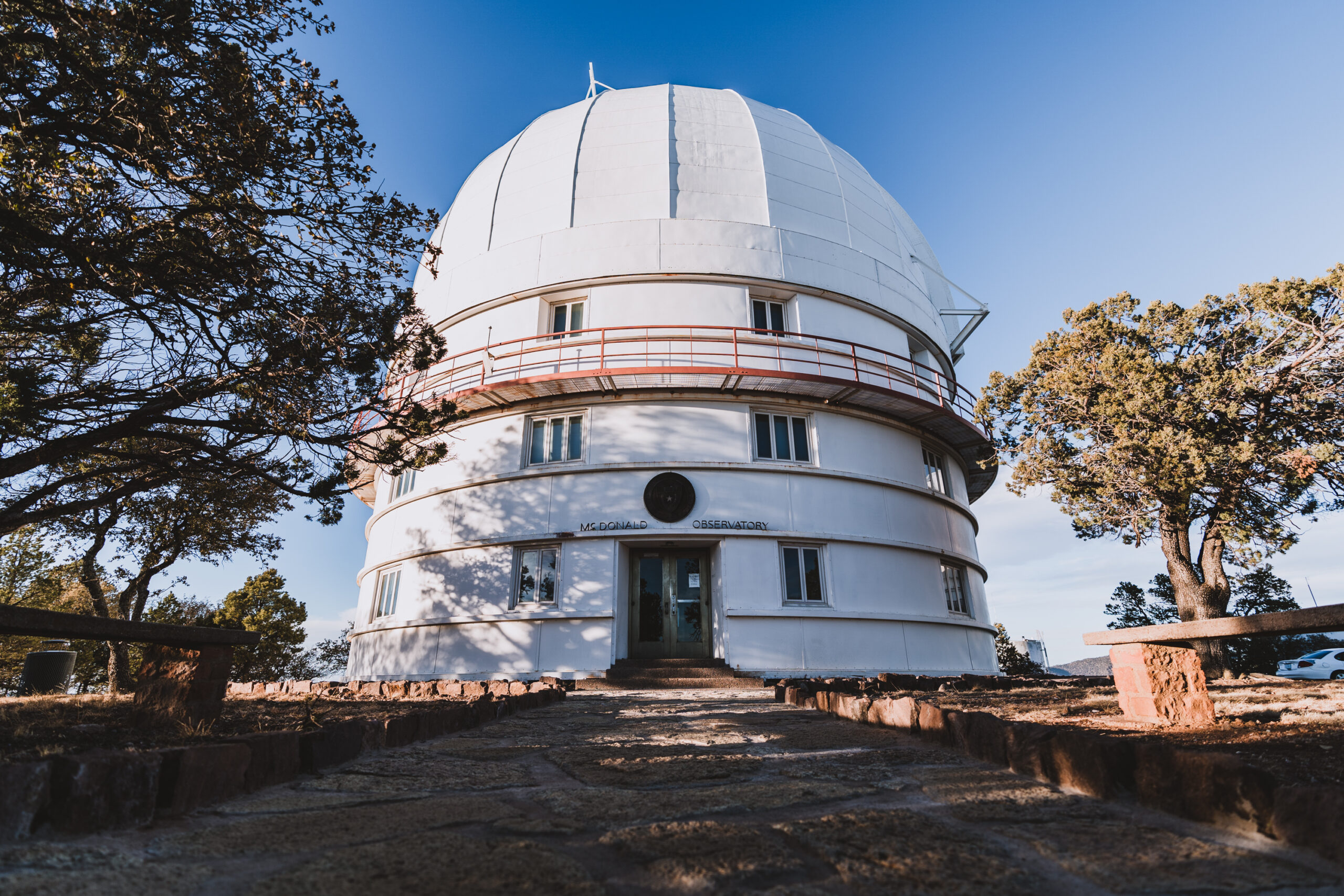
When the Otto Struve Telescope was completed in 1939, its dome housed the 82-inch (2.1-meter) telescope — then the second largest in the world — and living and sleeping quarters for the astronomers who used the telescope. Today, these rooms serve as offices and a library.
With its heavy steel mounting and black, half-open framework, the Struve is not just a scientific instrument, but a work of art. Like other telescopes at McDonald Observatory, its mirror is periodically removed and freshly coated with aluminum to maintain its sharp view of the heavens.
Research on the Telescope
Over its more than 80-year history, astronomers have used this telescope to study every type of astronomical object, from distant galaxies to stars in the Milky Way galaxy, to planets, moons, and other bodies of our solar system. The Struve has made some important discoveries, including that of Uranus’ fifth moon, Miranda, and Neptune’s second-largest moon, Nereid. It was used to discover carbon dioxide in the atmosphere of Mars and methane in the atmosphere of Saturn’s giant moon, Titan.
The telescope has received extensive upgrades over the years. It is now computer-controlled, and its instruments use electronic detectors to gather more light, allowing it to see fainter and more distant objects. With these updates, it’s still in regular use.
University of Texas astronomers and graduate students use most of the telescope’s time, but researchers from other institutions also get to experience its beauty and utility. Although it’s no longer among the world’s largest, the Otto Struve Telescope is still an important scientific instrument. It should continue to peer into the Universe for many years to come.
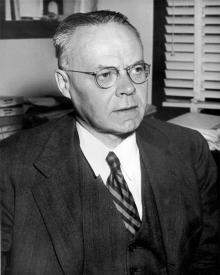
Who Was Otto Struve?
In 1966, the telescope that had been simply known as “the 82-inch,” was renamed for Otto Struve (1897-1963). He was the Observatory’s first director, serving from 1932 to 1947. He simultaneously directed the University of Chicago’s Yerkes Observatory. Struve’s own research involved spectroscopic observations of stars and gas in the Milky Way. For a time, he was editor of the prestigious Astrophysical Journal. He also served a term as president of the American Astronomical Society.
After leaving Yerkes and McDonald, he went on to direct two other observatories: Leuschner Observatory at UC Berkeley and the National Radio Astronomy Observatory.
Public Programs on the Otto Struve Telescope
On select nights throughout the year, McDonald Observatory offers public viewing programs on the Otto Struve Telescope. This makes it one of the largest telescopes in the world routinely made available for public viewing. During Special Viewing Nights, participants see a range of targets (weather permitting), from planets, to galaxies, to globular clusters, and more.
We also offer Special Viewing Nights on our 0.9-meter Telescope.
Click to View or Download Hi-Res Image
Telescope Facts
Primary Mirror:
Diameter: 2.08 meters (82 in.)
Weight: 1900 kg (4200 lbs.)
Thickness: 29.8 cm (11.75 in.)
Material: Pyrex
Telescope Tube:
Diameter: 2.64 m (8ft. 8 in.)
Length: 8.2 m (27 ft.)
Telescope Weight:
45 Tons
Dome:
Diameter: 19 meters (62 ft.)
Weight: 115 tons
Design:
Construction started: 1933
Construction completed: 1939
Telescope contractor: Warner and Swasey Company
Dome contractor: Warner and Swasey Company
Optics: C. Lundin
Primary Mirror:
Diameter: 2.08 meters (82 in.)
Weight: 1900 kg (4200 lbs.)
Thickness: 29.8 cm (11.75 in.)
Material: Pyrex
Telescope Tube:
Diameter: 2.64 m (8ft. 8 in.)
Length: 8.2 m (27 ft.)
Telescope Weight:
45 TonsDome:
Diameter: 19 meters (62 ft.)
Weight: 115 tons
Design:
Construction started: 1933
Construction completed: 1939
Telescope contractor: Warner and Swasey Company
Dome contractor: Warner and Swasey Company
Optics: C. Lundin
Information for Astronomers
To learn more about the Otto Struve Telescope, please visit UT Austin’s McDonald Observatory website for researchers.