
The McDonald Geodetic Observatory focuses on geodesy – the science of Earth’s shape, gravity, and rotation – and how these change over time. Its major components consists of:
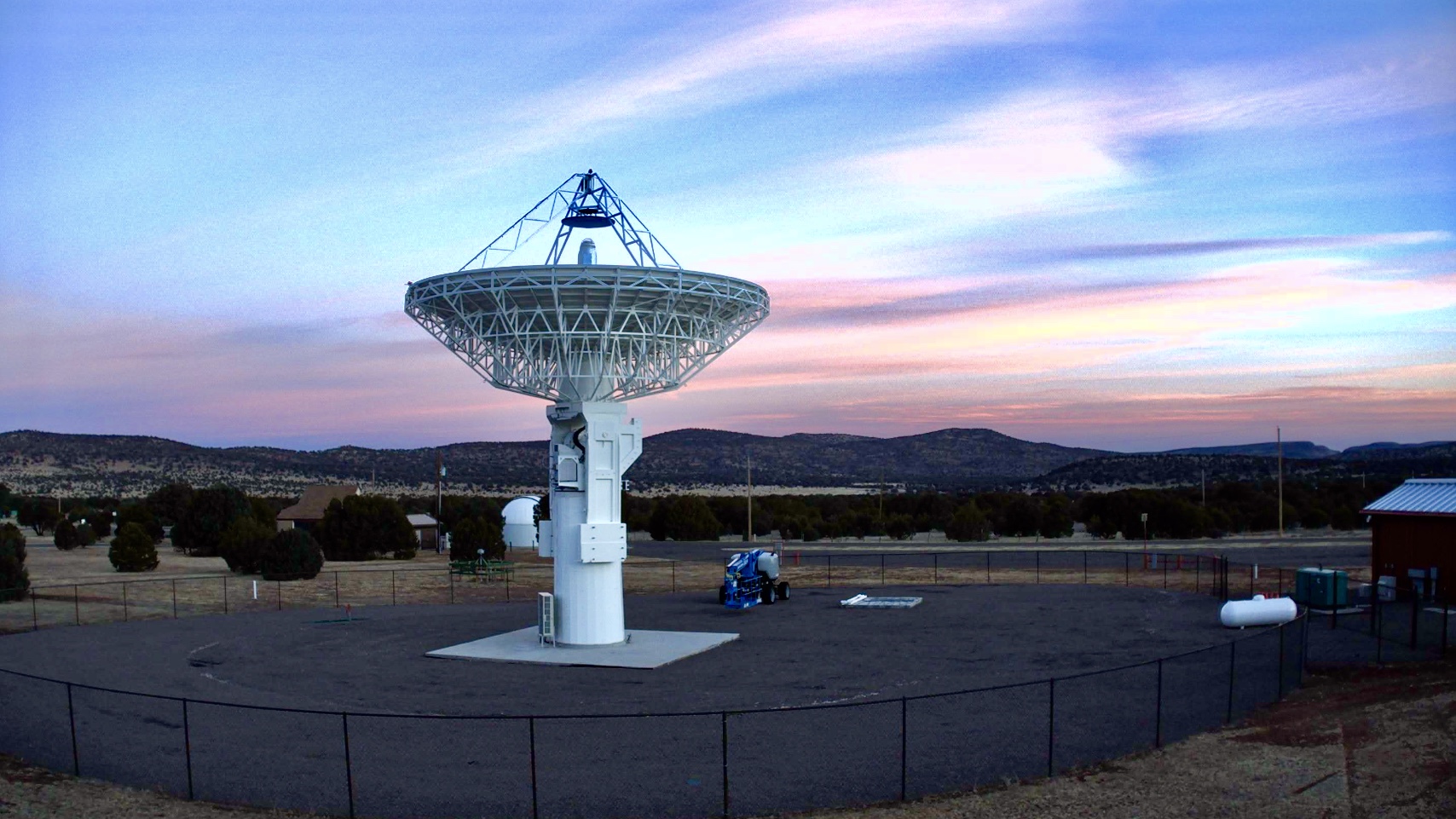
- A fast, fully steerable 39-foot-wide (12-meter-wide) radio telescope at the base of Mount Locke
- A laser ranging telescope on Mount Fowlkes near the Hobby-Eberly Telescope dome
- Ultra-precise Global Positioning System receivers
The McDonald Geodetic Observatory is a joint project by The University of Texas at Austin Center for Space Research, McDonald Observatory, and NASA’s Goddard Spaceflight Center. It is part of a global effort to create a “terrestrial reference frame” for scientists — a collection of landmarks that all other locations on Earth can be measured against precisely. The project helps scientists better understand Earth with the potential to minimize the effects of geohazards such as earthquakes, volcanic eruptions, sea level changes, and landslides.
Led and managed by the Center for Space Research, the McDonald Geodetic Observatory brings together scientists and engineers from many parts of the University, with diverse interests in space research, the study of global change, and the characterization of natural hazards. The team comes from UT’s Cockrell School of Engineering, Jackson School of Geosciences, and Applied Research Laboratory. The McDonald Observatory site and infrastructure belong to the College of Natural Sciences.
The McDonald Geodetic Observatory consists of more than a dozen stations at various locations around McDonald Observatory. The two largest stations host a laser ranging telescope located on Mount Fowlkes (near the Hobby-Eberly Telescope dome) and a 39-foot (12-meter) radio telescope dish at the base of Mount Locke (near the Frank N. Bash Visitors Center). Other stations host ultra-precise Global Positioning System receivers, weather-monitoring equipment, and more. NASA furnished the major scientific systems; the University funded infrastructure and additional science equipment.
McDonald Observatory is a particularly stable site for geodetic science, with no nearby tectonic activity, such as earthquakes, or large variations in annual rainfall. It also has relatively easy access to bedrock. As such, the site has been used for geodetic science for decades.
Click to View or Download Hi-Res Image
Information for Astronomers
To learn more about the McDonald Geodetic Observatory, please visit UT Austin’s McDonald Observatory website for researchers.