
By adopting night sky friendly lighting practices on your property, you can help reduce the negative effects of light pollution.
In addition to wasting energy and money, light pollution disrupts global wildlife and ecological balance, has been linked to negative consequences in human health, and negatively affects McDonald Observatory’s ability to do astronomy.
Night Sky Friendly Lighting Practices
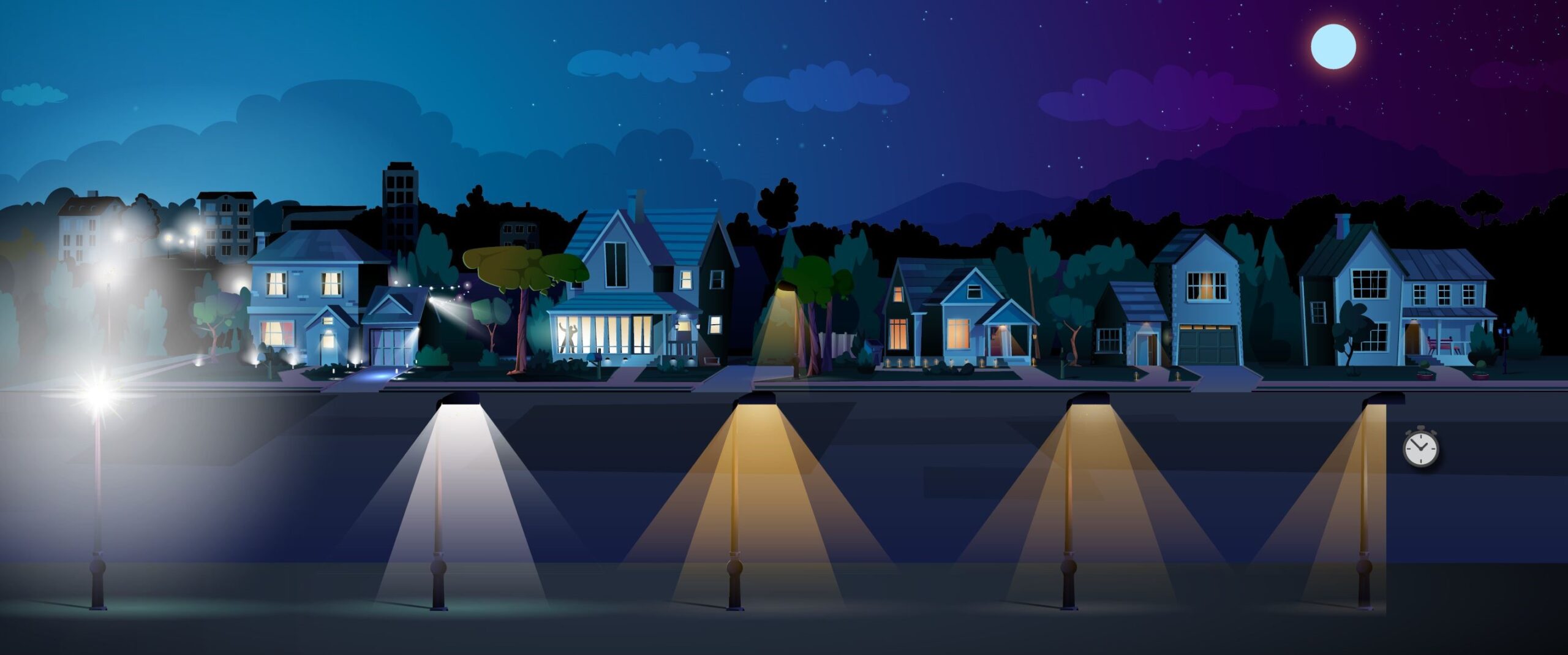
- Shielding: Light fixtures should be shielded such that the light source is not visible from above or from off-property. Lights should be aimed down at the ground.
- Color: Light sources should have a color temperature of 2,700K or below (soft white/amber).
- Intensity: Light sources should not emit more light than is necessary.
- Timing: Lights should have a clear purpose. Lights that are not serving their purpose, such as business signs or decorative lights after hours, should be turned off, put on a timer to turn off automatically, or only activated temporarily with a motion sensor.
More information about approved lighting practices is available on the Greater Big Bend International Dark Sky Reserve’s website.
If you live in Far West Texas and follow night sky friendly lighting practices, consider applying to McDonald Observatory’s Night Sky Friendly Lighting Recognition Program.
Buying Night Sky Friendly Light Fixtures
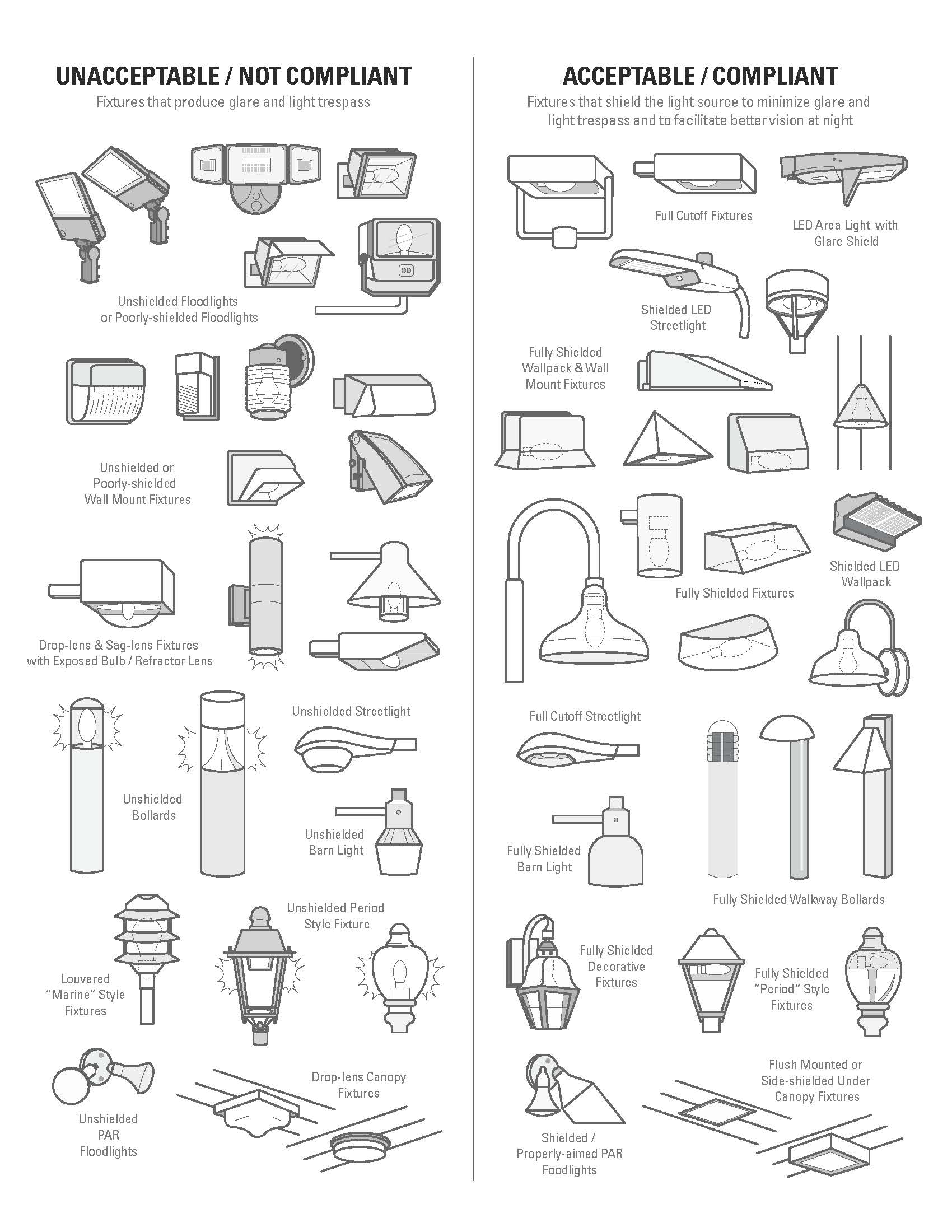
When shopping for light fixtures, look for shields which are flush or extend below the bottom of the bulb. Some fixtures may have shields that are too short to be effective. If you can see the bulb or light source from the edge of the property, it is not shielded well enough to protect night skies.
Wall-mounted floodlights, such as PAR-style lights commonly found on many homes and businesses, can easily be made night sky friendly by using a PAR38 size shielded fixture with an undersized PAR20 bulb, and tilted downwards.
Pay attention to the lumens a bulb emits when shopping. For most outdoor residential applications, it is usually not necessary to exceed 1000 lumens per bulb, and values around 500 lumens are typically more than enough. A lower lumen output can be used with a shielded fixture because the light is more focused.
Examples of Light Fixtures
Keywords for Shopping
Whether searching online or looking at packaging in a store, here are some phrases to look for:
- Dark-Sky Compliant
- IDA Seal of Approval
- Fully Shielded
- Full Cut-off
- Night Sky Friendly
- Bug Light
- Blue light blocking
- 2000K, 2200K, or 2700K Color Temperature
- Turtle Friendly
- Wildlife Friendly
- Florida Fish & Wildlife Certified
Far West Texas Lighting Ordinances
By state law the seven counties surrounding McDonald Observatory are required to have lighting ordinances in place to help protect the sky. These ordinances are separate from but overlap efforts related to the proposed Greater Big Bend International Dark Sky Reserve, which includes further measures to protect the night sky.
The Seven Counties Surrounding the Observatory:
- Jeff Davis
- Presidio
- Brewster
- Reeves
- Pecos
- Hudspeth
- Culberson
Within these counties are numerous municipalities which each have their own versions of outdoor lighting ordinances, such as Alpine, Marfa, Presidio, Valentine, and other cities. Unincorporated communities such as Fort Davis, Terlingua, Marathon, and others are subject to the county level ordinances.
Copies of some of these ordinances can be found on our Resources page [LINK: /darkskies/resources].
How Ordinances May Affect Your Property
Enforcement of lighting ordinances is the responsibility of the municipalities or counties that enact them.
Lighting ordinances almost always include a grandfathering clause, which states that fixtures installed before a certain date (usually the date the ordinance was enacted) are not subject to the ordinance, or only will be subject to the ordinance after a certain time period after being enacted. In most cases, that time period is 5 years. For Jeff Davis, Presidio, and Brewster Counties, and all municipalities within, all lights will need to be in compliance by 2026 when the grandfathering clauses expire. All new or replacement light fixtures installed must be compliant with the ordinance now.
While enforcement measures vary, in most cases violations are punishable by a fine determined by the municipality or county. Cases of violations are usually addressed as a result of a complaint to the county or code enforcement; police generally do not patrol streets to look for violations. In general, the role of these ordinances is to raise awareness of lighting practices and create recommendations for best practice rather than punish violators. Violators are notified by the county or municipality and given time to address the problem before any enforcement action is taken or fine issued.
Learn More
DarkSky International is a good resource and provides a seal of approval to light fixtures.
We also recommend the Greater Big Bend International Dark Sky Reserve’s website to learn more about night sky friendly lighting.
Still have questions? Contact us for answers.