
Hubble Spots Expanding Light Echo Around a Supernova
November 10, 2017
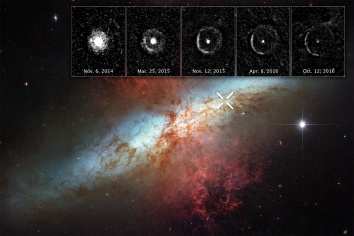
Voices reverberating off mountains and the sound of footsteps bouncing off walls are examples of an echo. Echoes happen when sound waves ricochet off surfaces and return to the listener.
Space has its own version of an echo. It’s not made with sound but with light, and occurs when light bounces off dust clouds.
The Hubble Space Telescope has just captured one of these cosmic echoes, called a “light echo,” in the nearby starburst galaxy M82, located 11.4 million light-years away. A movie assembled from more than two years’ worth of Hubble images reveals an expanding shell of light from a supernova explosion sweeping through interstellar space three years after the stellar blast was discovered. The “echoing” light looks like a ripple expanding on a pond. The supernova, called SN 2014J, was discovered on January 21, 2014.
This research was conducted by an international team of researchers led by Yi Yang of Texas A&M University, and including J. Craig Wheeler of The University of Texas at Austin.
“This is a spectacular use of the Hubble Space Telescope with cosmological implications for the nature of Type Ia supernovae and the dust around them,” Wheeler said.
A light echo occurs because light from the stellar blast travels at different distances to arrive at Earth. Some light echoes come to Earth directly from the supernova blast. Other light is delayed because it travels indirectly. In this case, the light bounding off a huge dust cloud that extends 300 to 1,600 light-years around the supernova and is being reflected toward Earth.
So far, astronomers have spotted only 15 light echoes around supernovae outside our Milky Way galaxy. Light echo deflections from supernovae are rarely seen because they must be nearby for a telescope to resolve them.
Related Posts
July 19, 2024
Astronomers Better Identify Distance to the Cygnus Loop
The Cygnus Loop is the ethereal wreckage of a supernova explosion that occurred some 17,000-25,000 years ago. It is a cloud of dust and gas, called a nebula, steadily expanding outward from the original blast site. Because it is relatively […]
July 24, 2024
Astronomers Image Cold Exoplanet 12 Light-Years Away
An international team of astronomers using NASA’s James Webb Space Telescope has directly imaged an exoplanet roughly 12 light-years from Earth. The planet, Epsilon Indi Ab, is one of the coldest exoplanets observed to date. The planet is several times […]
July 31, 2024
Astronomers Use AI to Find Elusive Stars ‘Gobbling Up’ Planets
Astronomers have recently found hundreds of “polluted” white dwarf stars in our home galaxy, the Milky Way. These are white dwarfs caught actively consuming planets in their orbit. They are a valuable resource for studying the interiors of these distant, […]