
Giant Magellan Telescope Launches Program to Enhance Accessibility in Astronomy Education
September 30, 2024
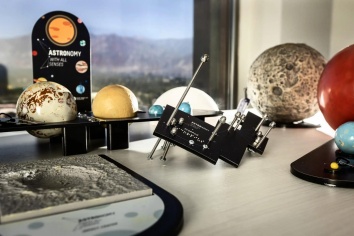
The Giant Magellan Telescope, for which The University of Texas in Austin is a founding partner, today announced the launch of Universo Expansivo, a new education program designed to increase accessibility in astronomy education, particularly for students with vision loss, through tactile astronomy kits and accompanying lesson plans.
Materials for Universo Expansivo were developed in collaboration with Parque Explora in Colombia and Red Aprender in Chile, and is supported by the U.S. Embassy in Chile and its network of 14 “American Spaces.” Following a successful pilot phase with six community organizations across Chile and the United States, the Giant Magellan now welcomes interested educators and members of the public to utilize the initiative’s free resources in both countries.
“Universo Expansivo reflects both the Giant Magellan’s priority in making astronomy more accessible, and our commitment to working with partner organizations to co-develop and implement equity-driven initiatives,” said Valerie Hirschberg, education and outreach manager for the Giant Magellan Telescope. “We are incredibly grateful for our collaborators who have helped make Universo Expansivo a reality throughout Chile and the United States.”
“Astronomy is for everyone,” added Taft Armandroff, director of UT Austin’s McDonald Observatory. “It connects us with our past, our future, and the endless possibilities of the cosmos. We are hopeful that these materials will be a valuable resource for educators and inspire a future generation of scientists.”
Universo Expansivo was developed in both English and Spanish for flexible use across various educational settings, including both in formal and informal learning environments. The tactile kit, designed by Parque Explora with the support of the International Astronomical Union, empowers students to explore astronomy concepts in our Universe — such as the scale and relative distances of celestial bodies — through tactile materials. The complementary manual of lesson plans, designed by Red Aprender, engages students in learning about astronomical phenomenon — such as eclipses — through auditory, kinesthetic, tactile, and multisensory activities.
“We are excited and proud to have created the teaching manual for Universo Expansivo,” said Francisca Schweitzer, executive director of Red Aprender. “In the process, we spoke with many people and learned a great deal about both astronomy and the importance of inclusion and accessibility. We believe in highlighting diverse abilities. Everyone needs adaptations — there is no ‘average’ human being. Embracing the creation of diverse learning experiences opens new mental pathways, making it a journey that fosters learning and sparks curiosity in everyone.”
The accessible multisensory approach of Universo Expansivo was successfully piloted earlier this year in workshops at the Braille Institute of America, California Science Center, Fundación Mustakis, Las Campanas Observatory, Museo Interactivo Mirador, and in several schools across the Pasadena Unified School District. Workshops involved more than 100 participants in the Chilean communities of Santiago and the Coquimbo region surrounding the Giant Magellan site, and California communities in Los Angeles County near the Giant Magellan’s headquarters.
“The hands-on space exploration piqued students’ curiosities and creatively expanded their understanding of space. What a memorable program for our students!” said Madeleine Hernandez, manager of national and youth programs for the Braille Institute of America.
“Universo Expansivo exemplifies the Giant Magellan Telescope’s commitment to promote science education and open opportunities to engage with astronomy to everyone. The students not only receive valuable learning experiences, but the curiosity fostered extends far beyond the classroom,” said Oscar Contreras-Villarroel, vice president and representative in Chile for the Giant Magellan Telescope. “With the support of the U.S. Embassy in Chile and its 14 ‘American Spaces’ around the country, the alliance strengthens Chilean STEM education through Universo Expansivo.”
Universo Expansivo is now ready for broader implementation in Chile and the United States, featuring free tactile kits, teacher workshops and lesson plans, as well as free public educational resources available for download. The Giant Magellan Telescope welcomes new partners and communities interested in engaging with Universo Expansivo at universoexpansivo.org.
Related Posts
October 15, 2024
Giant Magellan Telescope Begins Primary Mirror Support System Testing
The Giant Magellan Telescope, of which The University of Texas at Austin is a founding partner, today announced the successful installation of one of its completed 27.6-foot-diameter (8.4-meter-diameter) primary mirrors into a support system prototype at the University of Arizona’s Richard F. Caris […]
December 13, 2024
Northwestern University Joins Giant Magellan Telescope International Consortium
The University of Texas at Austin joined the Giant Magellan Telescope today in announcing that Northwestern University has joined its international consortium to construct the $2.54 billion observatory. Home to the world-renowned Center for Interdisciplinary Exploration and Research in Astrophysics (CIERA) and the newly founded NSF-Simons AI Institute […]
June 13, 2024
Giant Magellan Telescope Enclosure Ready for Construction
The University of Texas at Austin joined Giant Magellan Telescope and IDOM today in announcing that the telescope’s enclosure, set to be one of the world’s largest astronomical facilities, passed its final design review and is now ready for construction in Chile. The review marks a […]