
First Images from JWST’s Largest General Observer Program
By UT Austin
March 9, 2023
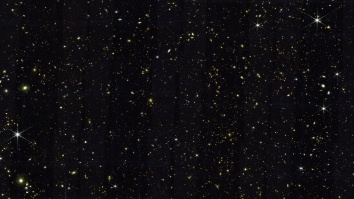
The first images from the largest program in the James Webb Space Telescope’s first year show many types of galaxies, including dazzling examples of spiral galaxies, gravitational lensing and evidence of galaxy mergers. Scientists from the COSMOS-Web program released mosaic images taken in early January by JWST’s Near-Infrared Camera (NIRCam) and Mid-Infrared Instrument (MIRI).
“This first snapshot of COSMOS-Web contains about 25,000 galaxies — an astonishing number larger than even what sits in the Hubble Ultra Deep Field,” said Caitlin Casey, associate professor of astronomy at The University of Texas at Austin and co-principal investigator of COSMOS-Web. “It’s one of the largest JWST images taken so far. And yet it’s just 4 percent of the data we will get for the full survey. When it is finished, this deep field will be astoundingly large and overwhelmingly beautiful.”
Related Posts
July 19, 2024
Astronomers Better Identify Distance to the Cygnus Loop
The Cygnus Loop is the ethereal wreckage of a supernova explosion that occurred some 17,000-25,000 years ago. It is a cloud of dust and gas, called a nebula, steadily expanding outward from the original blast site. Because it is relatively […]
July 24, 2024
Astronomers Image Cold Exoplanet 12 Light-Years Away
An international team of astronomers using NASA’s James Webb Space Telescope has directly imaged an exoplanet roughly 12 light-years from Earth. The planet, Epsilon Indi Ab, is one of the coldest exoplanets observed to date. The planet is several times […]
July 31, 2024
Astronomers Use AI to Find Elusive Stars ‘Gobbling Up’ Planets
Astronomers have recently found hundreds of “polluted” white dwarf stars in our home galaxy, the Milky Way. These are white dwarfs caught actively consuming planets in their orbit. They are a valuable resource for studying the interiors of these distant, […]