
McDonald Observatory, Partners Create World’s Largest International Dark Sky Reserve
By Rebecca Johnson
April 7, 2022
The University of Texas at Austin’s McDonald Observatory, The Nature Conservancy – Davis Mountain Preserve, and the International Dark-Sky Association (IDA) are pleased to announce the certification of the Greater Big Bend International Dark Sky Reserve. The designation, granted by the International Dark-Sky Association, recognizes the commitment of organizations, governments, businesses and citizens in the region to maintain dark skies. Protecting this resource benefits not only astronomical research, but also wildlife, ecology and tourism.
Encompassing more than 38,850 square kilometers (15,000 square miles), the new Greater Big Bend International Dark Sky Reserve is the largest certified International Dark Sky Place to date. Moreover, this is the only Reserve to incorporate protected lands across an international border, including portions of western Texas, United States and protected lands in Coahuila and Chihuahua, northern Mexico.
“The certification of this Reserve is truly a historic moment for the dark-sky movement,” stated Ashley Wilson, Director of Conservation of IDA. “We are recognizing decades of hard work, nocturnal environmental stewardship, stellar outreach programs, and multiple local incentives to provide tangible and feasible solutions that limit the spread of excessive and wasteful artificial light. Greater Big Bend demonstrates that partnerships and dark-sky efforts at the landscape scale can become a reality with the dedication from a team of key stakeholders and passionate communities.”
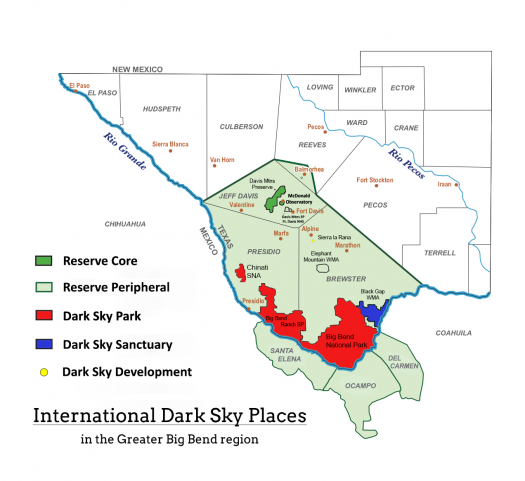
The core of the Reserve, where the protection for dark skies is the strongest, is formed by the lands of McDonald Observatory and The Nature Conservancy’s Davis Mountain Preserve.
“This Reserve protects both the scientific research and public education missions of McDonald Observatory,” said Taft Armandroff, McDonald Observatory Director. “Since 1939, McDonald Observatory has enabled the study of the cosmos by faculty, students, and researchers at The University of Texas at Austin and other Texas institutions of higher learning, with topics ranging from planets orbiting nearby stars to the accelerating expansion of the universe.”
The Nature Conservancy (TNC) is one of the major partners that helped make the Reserve a reality. The Reserve will protect numerous nocturnal wildlife habitats and migration corridors passing through the Big Bend region.
“We are honored to be a part of the Greater Big Bend International Dark Sky Reserve,” said Kaylee French, education and outreach coordinator for TNC’s Davis Mountain Preserve. “This collaboration uniquely brings together working partners across a wide range which spans international borders. Our dark skies are an invaluable natural resource which we are only able to preserve by working together.
“We thank the International Dark-Sky Association for helping us to be responsible stewards of this now and forever protected resource.”
The full extent of the Reserve spans the Rio Grande, from the Davis Mountains of western Texas to the Sierra del Carmen of northern Mexico. In the United States, it includes the Texas counties of Jeff Davis, Brewster, Presidio, and a small section of Reeves County. Participating protected lands also include several certified International Dark Sky Places such as Big Bend National Park, the Big Bend Ranch State Park Complex, and Black Gap Wildlife Management Area.
South of the Rio Grande in Mexico, the Reserve includes privately managed lands in Maderas del Carmen, Ocampo, and Cañón de Santa Elena.
It took a large and diverse group of advocates on both sides of the border to make the Reserve a reality.
“Without the broad regional support and the long-standing efforts to preserve the natural beauty of the Big Bend region, a Dark Sky Reserve of this scale would not have been possible,” said Teznie Pugh, Superintendent of McDonald Observatory. “It has been a true community effort, and the people of the area should be proud of what we have all achieved together.
“The counties surrounding McDonald Observatory — Jeff Davis, Presidio, Brewster, Culberson, Hudspeth, Reeves, and Pecos — have had lighting ordinances in place for several decades,” explained Pugh. “Partnerships between the national and state parks, conservation groups, local landowners, local government officials, and the observatory are long standing, and the Reserve is the culmination of those efforts.”
Four counties and five municipalities within the proposed Reserve periphery, or the area surrounding the dark core area, updated their existing lighting ordinances with relevant language to ensure their lighting reflects best practices and supports the efforts of protecting the core’s dark skies.
Related Posts
July 2, 2024
Bass Foundation Gift Strengthens Outreach at McDonald Observatory
McDonald Observatory is honored to announce a generous gift of $4 million from the Harry W. Bass Jr. Foundation. Funds will support updates to McDonald Observatory’s Frank N. Bash Visitors Center and improve and expand the Observatory’s visitor experience. “We […]
August 14, 2024
McDonald Observatory Welcomes New Assistant Director for Research Support
McDonald Observatory is pleased to announce the appointment of B-G Andersson as its new assistant director for research support. As a part of the Observatory’s management team, the assistant director oversees the allocation of observing time on the telescopes and […]
August 22, 2024
Board of Visitors 2025 Summer Meeting Takes Place July 26-27
Our thanks for another wonderful Board of Visitors meeting! Over 207 members and guests joined us to experience VIP access to McDonald Observatory, learn about the cutting-edge science taking place there, and to connect with one another. Thanks to clear […]