
New Telescope Dedicated at McDonald Observatory
By Rebecca Johnson
October 31, 2019
A new telescope was dedicated yesterday at The University of Texas at Austin’s McDonald Observatory. The 1-meter telescope, funded by the Heising-Simons Foundation, is part of the Las Cumbres Observatory (LCO) global network of robotic telescopes.
“We are very pleased to host this new telescope and to conduct additional research by Texas astronomers on the LCO network, and we thank the Heising-Simons Foundation and the Las Cumbres Observatory for making this additional research tool possible,” said Taft Armandroff, Director of McDonald Observatory.
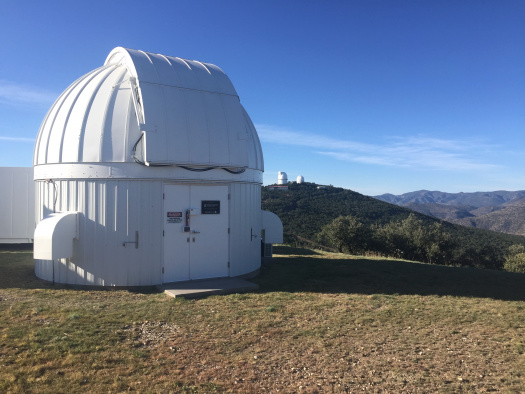
The new telescope is the second LCO telescope of this size at McDonald. The first was dedicated in 2012, and also was the first 1-meter telescope to come online in LCO’s global network. Today, the network also includes telescopes in Hawaii, Chile, South Africa, Israel, the Canary Islands, and Australia.
The LCO telescopes at McDonald provide additional science resources to the faculty, research scientists, and graduate students of the UT Austin astronomy program. In exchange for hosting the telescopes, Texas astronomers are granted access to LCO’s entire network.
Texas astronomers use the LCO telescopes for a variety of research projects, including hunting for extrasolar planets and studying the exploding stars known as supernovae. The addition of a new LCO telescope at McDonald doubles UT Austin astronomers’ share of observing time on the network.
The dedication ceremony featured remarks from representatives of the Heising-Simons Foundation, Las Cumbres Observatory, and McDonald Observatory.
Assistant Director Anita Cochran delivered a presentation that she and Director Taft Armandroff developed on “Key Science Areas Where LCO Will Help Texas Faculty, Students, and Postdocs.” Following her remarks, McDonald astronomer Cynthia Froning presented a talk entitled “Working Together: What Ground and Space Telescopes Can Tell Us about the Habitability of Exoplanets Around Dwarf Stars.”
Related Posts
July 19, 2024
Astronomers Better Identify Distance to the Cygnus Loop
The Cygnus Loop is the ethereal wreckage of a supernova explosion that occurred some 17,000-25,000 years ago. It is a cloud of dust and gas, called a nebula, steadily expanding outward from the original blast site. Because it is relatively […]
July 24, 2024
Astronomers Image Cold Exoplanet 12 Light-Years Away
An international team of astronomers using NASA’s James Webb Space Telescope has directly imaged an exoplanet roughly 12 light-years from Earth. The planet, Epsilon Indi Ab, is one of the coldest exoplanets observed to date. The planet is several times […]
July 31, 2024
Astronomers Use AI to Find Elusive Stars ‘Gobbling Up’ Planets
Astronomers have recently found hundreds of “polluted” white dwarf stars in our home galaxy, the Milky Way. These are white dwarfs caught actively consuming planets in their orbit. They are a valuable resource for studying the interiors of these distant, […]