
Astronomers Solve Mystery of Formation of First Supermassive Black Holes
September 28, 2017
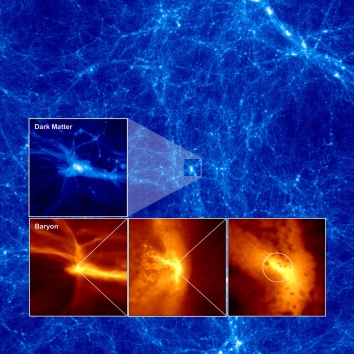
An international team of researchers has successfully used a supercomputer simulation to recreate the formation of a massive black hole from supersonic gas streams left over from the Big Bang. The study will be published tomorrow in the journal Science, in a paper led by Shingo Hirano of The University of Texas at Austin’s Department of Astronomy.
“This is significant progress. The origin of the monstrous black holes has been a long-standing mystery and now we have a solution to it,” Hirano said.
Recent discoveries of supermassive black holes 13 billion light-years away, corresponding to when the universe was just five per cent of its present age, pose a serious challenge to the theory of black hole formation and evolution. The physical mechanisms that form black holes and drive their growth are poorly understood.
Theoretical studies have suggested these black holes formed from remnants of the first generation of stars, or a direct gravitational collapse of a massive primordial gas cloud. However, such theories either have difficulty in forming supermassive black holes fast enough, or resort to very particular conditions.
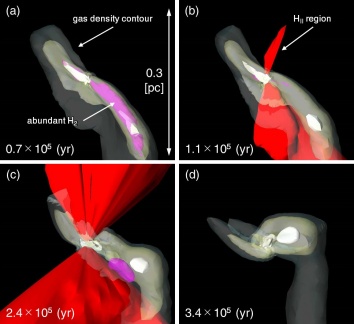
The research team, led by Principal Investigator Naoki Yoshida of Japan’s Kavli Institute for the Physics and Mathematics of the Universe, identified a promising physical process through which a massive black hole could form fast enough. The key was the supersonic gas motions with respect to dark matter. The team’s supercomputer simulations showed a massive clump of dark matter had formed when the universe was 100 million years old. Supersonic gas streams generated by the Big Bang were caught by dark matter to form a dense, turbulent gas cloud. Inside, a protostar started to form, and because the surrounding gas provided more than enough material for it to feed on, the star was able to grow extremely big in a short amount of time without releasing a lot of radiation.
“Once reaching the mass of 34,000 times that of our Sun, the star collapsed by its own gravity, leaving a massive black hole,” Yoshida said. “These massive black holes born in the early universe continued to grow and merge together to become a supermassive black hole.”
“The number density of massive black holes is derived to be approximately one per a volume of three billion light-years on a side — remarkably close to the observed number density of supermassive black holes,” Hirano added.
The result from this study will be important for future research into the growth of massive black holes. Especially with the increased number of black hole observations in the far universe that are expected to be made when NASA’s James Webb Space Telescope is launched next year.
Related Posts
July 19, 2024
Astronomers Better Identify Distance to the Cygnus Loop
The Cygnus Loop is the ethereal wreckage of a supernova explosion that occurred some 17,000-25,000 years ago. It is a cloud of dust and gas, called a nebula, steadily expanding outward from the original blast site. Because it is relatively […]
July 24, 2024
Astronomers Image Cold Exoplanet 12 Light-Years Away
An international team of astronomers using NASA’s James Webb Space Telescope has directly imaged an exoplanet roughly 12 light-years from Earth. The planet, Epsilon Indi Ab, is one of the coldest exoplanets observed to date. The planet is several times […]
July 31, 2024
Astronomers Use AI to Find Elusive Stars ‘Gobbling Up’ Planets
Astronomers have recently found hundreds of “polluted” white dwarf stars in our home galaxy, the Milky Way. These are white dwarfs caught actively consuming planets in their orbit. They are a valuable resource for studying the interiors of these distant, […]