
Upgraded Hobby-Eberly Telescope dedicated April 9; Dark energy survey, other cutting-edge science on the way
April 9, 2017
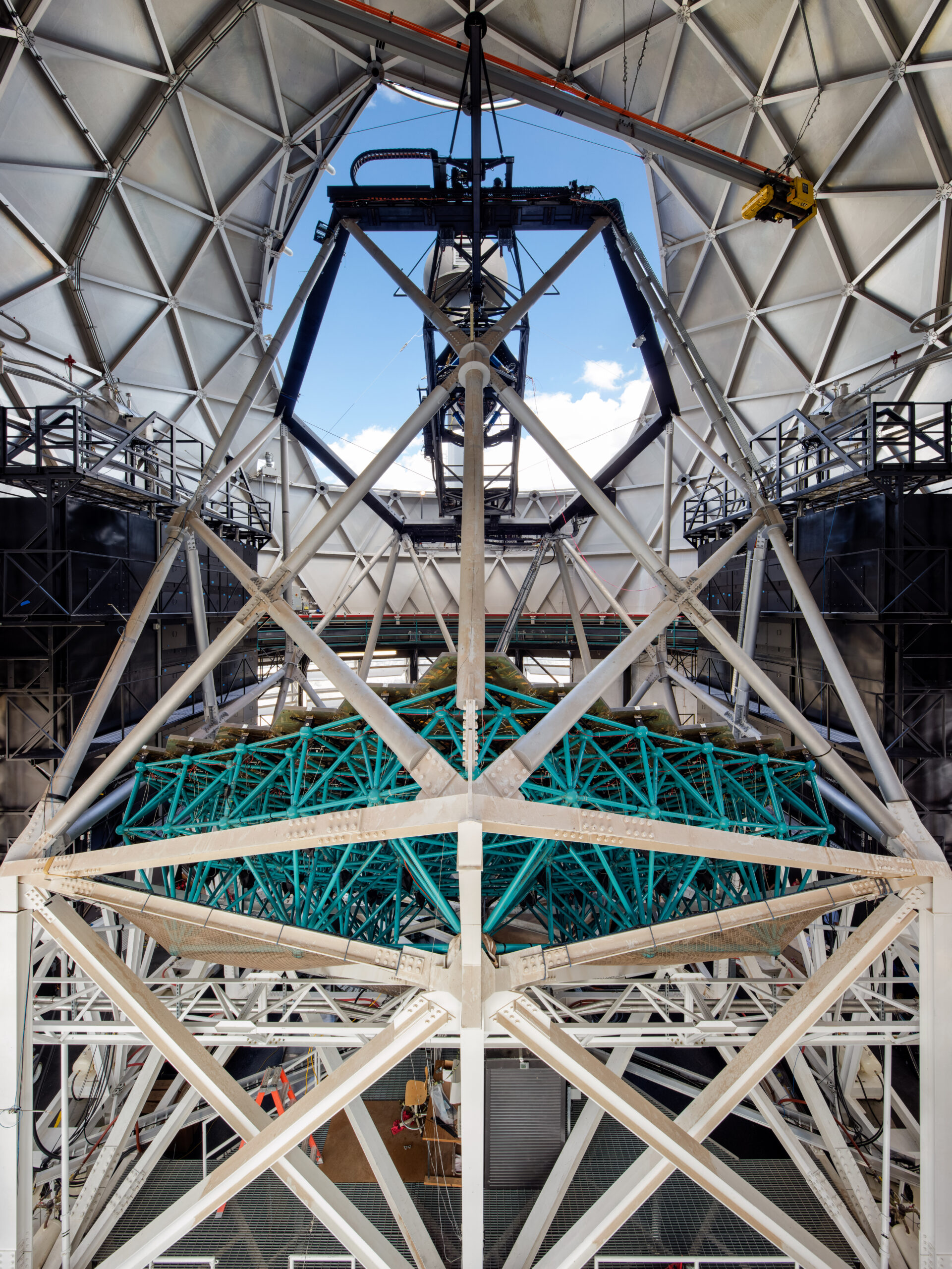
The world’s third-largest telescope, the 10-meter Hobby-Eberly Telescope (HET) located at McDonald Observatory in West Texas, has completed a multiyear $40 Million upgrade to enable it to take on the biggest challenges in astronomy today: unraveling the mystery of dark energy, probing distant galaxies and black holes, discovering and characterizing planets around other stars and much more. The HET Board is celebrating with a dedication ceremony today.
“The entire Board, as well as the HET astronomy community, are excited about the telescope upgrade and the new science it will enable,” said Dr. Larry Ramsey, chair of the HET Board and professor of astronomy at Penn State. “The upgraded HET will conduct the first major study of how dark energy changes over time and we all look forward to new and exciting results in this area and others.”
HET’s upgrade included a variety of aspects. The telescope’s field of view has been expanded to 70 percent of the diameter of the full Moon and now views an area of sky 120 times larger than before. And HET now sports an innovative new set of optics. “The Harold C. Simmons Dark Energy Optical System is one of the most complex optical systems ever deployed in astronomy,” said McDonald Observatory Director Dr. Taft Armandroff of The University of Texas at Austin. The Simmons System rides on the telescope’s new tracker, or “top end,” which enables tracking and guiding on cosmic targets.
The upgrade is an integral part of the upcoming Hobby-Eberly Telescope Dark Energy Experiment (HETDEX), a four-year project starting later this year that will study dark energy, the mysterious force causing the universe’s rate of expansion to speed up. This survey will look back 11 billion years and determine if dark energy has changed over time.
The HET was originally dedicated in 1997. It is a partnership between The University of Texas at Austin, Penn State, and two German institutions, Georg-August-Universität Göttingen and Ludwig-Maximilians-Universität München.
Today’s event will welcome Texas elected officials, philanthropic donors, leadership from The University of Texas at Austin and Penn state, officials from the National Science Foundation and scientists. The telescope upgrade was funded by a combination of federal, state and private sources.
Related Posts
July 19, 2024
Astronomers Better Identify Distance to the Cygnus Loop
The Cygnus Loop is the ethereal wreckage of a supernova explosion that occurred some 17,000-25,000 years ago. It is a cloud of dust and gas, called a nebula, steadily expanding outward from the original blast site. Because it is relatively […]
July 24, 2024
Astronomers Image Cold Exoplanet 12 Light-Years Away
An international team of astronomers using NASA’s James Webb Space Telescope has directly imaged an exoplanet roughly 12 light-years from Earth. The planet, Epsilon Indi Ab, is one of the coldest exoplanets observed to date. The planet is several times […]
July 31, 2024
Astronomers Use AI to Find Elusive Stars ‘Gobbling Up’ Planets
Astronomers have recently found hundreds of “polluted” white dwarf stars in our home galaxy, the Milky Way. These are white dwarfs caught actively consuming planets in their orbit. They are a valuable resource for studying the interiors of these distant, […]