
Astronomers Quimby, Wheeler Win Hyer Award from American Physical Society’s Texas Section
October 22, 2008
Recent University of Texas at Austin doctoral graduate Robert Quimby of the California Institute of Technology and his adviser, University of Texas at Austin astronomy professor J. Craig Wheeler, have won the Hyer Award from the Texas Section of the American Physical Society for excellence in physics-related research by a graduate student and adviser at a Texas higher education institution.
The Hyer Award recognized Quimby’s work on his Texas Supernova Search, in which he discovered two of the most intrinsically bright exploding stars, called supernovae, ever detected. The award was presented this past weekend at a meeting of the Texas Section of the American Physical Society in El Paso.
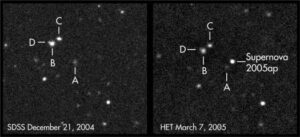
Quimby discovered supernovae 2006gy and 2005ap, among others, with the Robotic Optical Transient Search Experiment at the university’s McDonald Observatory in West Texas. He identified them as amazingly powerful explosions after gauging their distance by studying them with the Hobby-Eberly Telescope at McDonald, one of the world’s largest optical telescopes.
Related Posts
July 2, 2024
Bass Foundation Gift Strengthens Outreach at McDonald Observatory
McDonald Observatory is honored to announce a generous gift of $4 million from the Harry W. Bass Jr. Foundation. Funds will support updates to McDonald Observatory’s Frank N. Bash Visitors Center and improve and expand the Observatory’s visitor experience. “We […]
August 14, 2024
McDonald Observatory Welcomes New Assistant Director for Research Support
McDonald Observatory is pleased to announce the appointment of B-G Andersson as its new assistant director for research support. As a part of the Observatory’s management team, the assistant director oversees the allocation of observing time on the telescopes and […]
August 22, 2024
Board of Visitors 2025 Summer Meeting Takes Place July 26-27
Our thanks for another wonderful Board of Visitors meeting! Over 207 members and guests joined us to experience VIP access to McDonald Observatory, learn about the cutting-edge science taking place there, and to connect with one another. Thanks to clear […]