
What Are Astronomers Doing?
Telescopes Are Windows To the Universe
Astronomers use them to study everything from the asteroids and planets in our own solar system to galaxies billions of light-years away in space and time. Though they bring the mysteries of the universe to us, their workings are anything but mysterious. They gather and focus light from objects in the sky, so that it can be directed into an instrument attached to the telescope, and ultimately, studied in detail by a scientist. At McDonald Observatory, we have several telescopes, built at various times since the Observatory's founding in the 1930s.
Here is an introduction to the telescopes that McDonald Observatory astronomers use for their research:
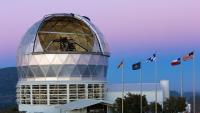
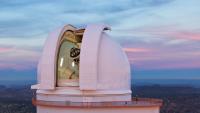
The Hobby-Eberly Telescope With its 11-meter (433-inch) mirror, the Hobby-Eberly Telescope (HET) is one of the world's largest optical telescopes. It was designed specifically for spectroscopy, the decoding of light from stars and galaxies to study their properties. This makes it ideal for searching for planets around other stars and studying distant galaxies, exploding stars, black holes, and more. The telescope is especially suited to conduct large survey projects using spectroscopy. More »
|
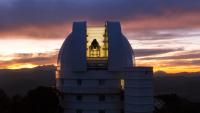
2.7-meter Harlan J. Smith Telescope McDonald Observatory's Smith Telescope was third largest in the world when completed in 1969. Its light-gathering power is a quarter of a million times greater than that of the unaided human eye. More »
|
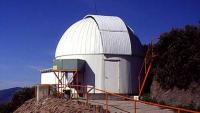
2.1-meter Otto Struve Telescope Completed in 1938, the Struve Telescope is McDonald Observatory's oldest. It is named in honor of the Observatory's first director. More »
|
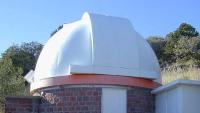
0.8-meter Telescope McDonald Observatory is often cited for the Hobby-Eberly Telescope,
one of the largest telescopes in the world. However, McDonald also
hosts a number of smaller yet effective tools. The Harlan J. Smith 2.7
meter and Otto Struve 2.1 meter telescopes are among these, but the
smallest telescope at McDonald Observatory is the 0.8 meter. More »
|
Multiple Telescopes Sometimes it takes more than one tool to crack a tough problem. More »
|
Non-McDonald TelescopeOftentimes McDonald Observatory astronomers take their research to sites other than McDonald. More »
|
0.9-meter Telescope The 0.9-meter Telescope is often used for public and educational programs at McDonald Observatory. More »
|
Visitors Center Telescopes The Frank N. Bash Visitors Center at McDonald Observatory has a range of telescopes it uses for public programs. More »
|
This program is supported by the National Science Foundation under grant AST 0227870. Any opinions, findings, and conclusions or recommendations expressed in this material are those of the author and do not necessarily reflect the views of the National Science Foundation.
|
|