
Home Contact | About | Friends of McDonald | StarDate Online | Sign up for Sky Tips
McDonald Observatory McDonald Observatory
SupportVisitorsTeachersNewsResearchGift Shop
What Are Astronomers Doing?
Sandiford Cassegrain Echelle Spectrometer


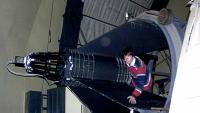
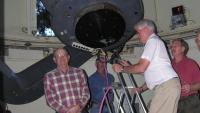
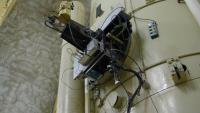
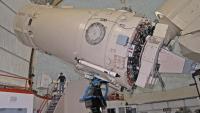
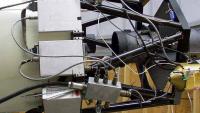
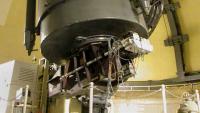
The Sandiford Cassegrain Eschelle Spectrometer (bottom) is shown here mated to the Otto Struve Telescope.

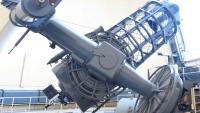
Light from the primary mirror is reflected by a secondary mirror to an instument attached to the telescope through a hole in the primary mirror.

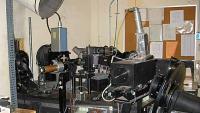
The Sandiford Cassegrain Echelle Spectrometer is an instrument often used on the 2.1-meter Otto Struve Telescope. It is a spectrometer, which means that it spreads incoming light into its component wavelengths for astronomers to study. The light is spread by an echelle, which is a special type of diffraction grating.

The Sandiford Cassegrain Echelle Spectrometer, or CE for short, is mounted on the telescope at the Cassegrain focus of the telescope. This focus position is located behind the back of the primary mirror. Light that enters the telescope is reflected off the primary mirror, which is 2.1 meters in diameter. The primary mirror directs the light to a smaller secondary mirror near the top of the telescope tube, and the secondary mirror reflects the light back down the telescope tube, through a hole in the primary mirror, and into the instrument. The instrument is placed such that it intercepts the light when the light is brought into focus.

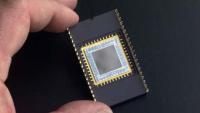
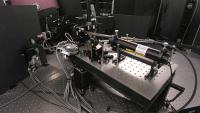
Once inside CE, light must pass through a variety of optics before it is measured. First, it is directed through a narrow slit, which shapes the incoming beam of light into a very skinny rectangle. This line of light is the most convenient way to create a tidy spectrum. Mirrors reflect the light towards an echelle, which is a special type of diffraction grating. The echelle separates the light into its component colors. The separated light is then reflected through a filter expressly designed to keep different parts of the spectrum from overlapping, and finally to a charged coupled device (CCD). The CCD is a light detector that records the spectrum and sends it to a computer in digital form for astronomers to study.

CE is a high resolution instrument, meaning that it is capable of separating light into very fine divisions. High resolution allows astronomers to see more detailed properties of the objects they are studying. CE can detect light of wavelengths between 370 nm and 1100 nm very efficiently. Since its introduction as an instrument, it has been used primarily to study the spectra of different kinds of stars to determine their composition, motions, and structure.


The Sandiford Cassegrain Echelle Spectrometer was named in honor of the late Brendan Sandiford, a McDonald Observatory employee who helped develop the instrument in 1991.

Other Instruments

Argos 
Cassegrain Spectrograph 
Charged Coupled Devices 
Diffraction Gratings 
Eyepiece 
Guiders 
High Resolution Spectrograph 
Imaging Grism Instrument and Polarimeter (IGI, IGP) 
Linear Polarimeter 
Marcario Low Resolution Spectrograph 
Medium Resolution Spectrograph 
Millisecond InfraRed Astrophysical Spectrophotometer 
Multiple Instruments 
Observer-provided instrument 
P45 Photometer 
Prime Focus Corrector 
Robert G. Tull Coudé Spectrograph 
UBVRI filters 
VIRUS-P 

Let us know what you think -- take our survey.


© 2002-2010 The University of Texas McDonald Observatory
Last Modified: